
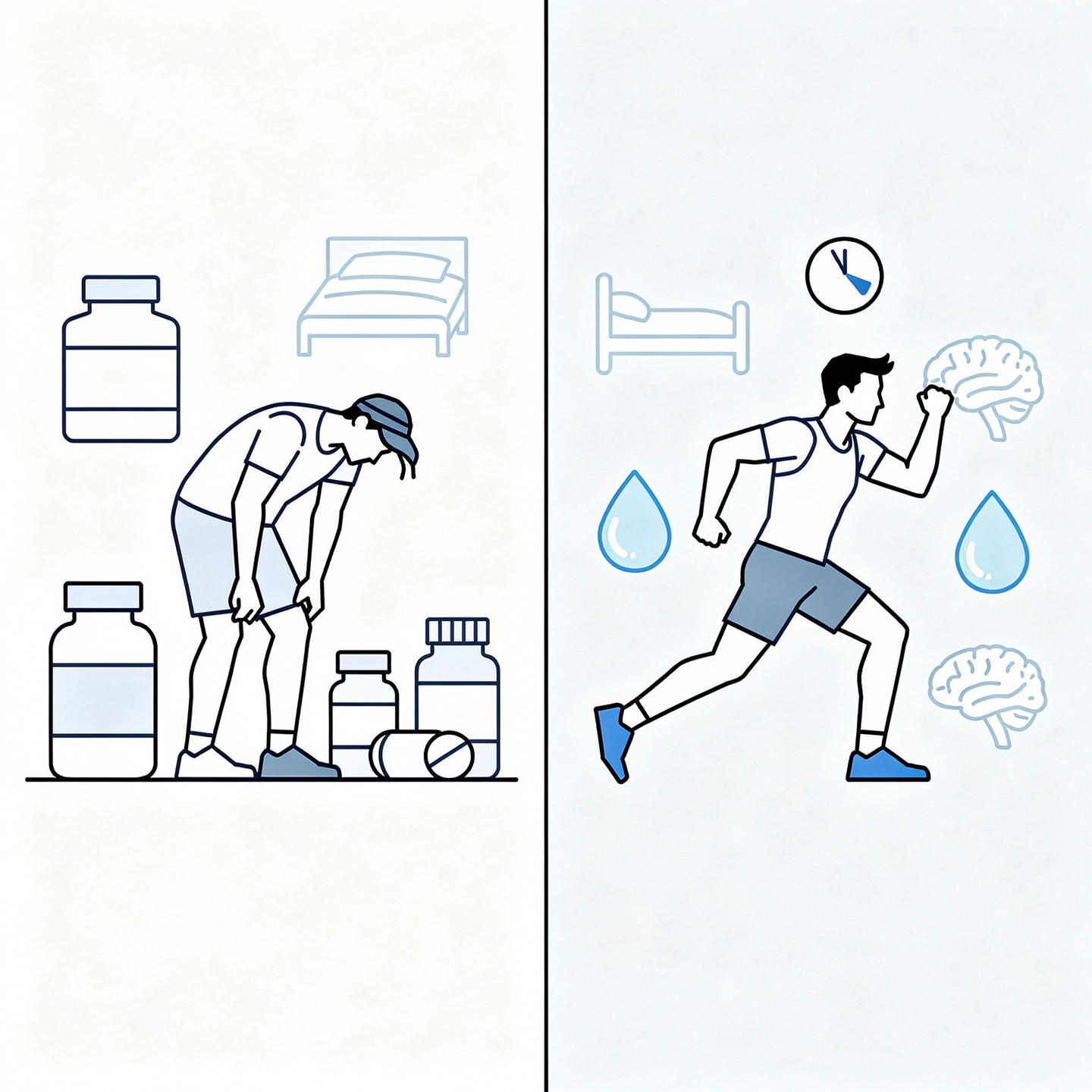

Why Athletes Waste Money on Recovery Supplements
Persistent soreness steals training quality. Dragging through sessions feeling wrecked from days ago, watching weights feel heavier while supplement bottles pile up—BCAAs, glutamine, magnesium. Spending $50-200 monthly with minimal improvement. This 60-page PDF guide delivers five science-backed methods to optimize recovery without a single supplement purchase, saving $500-1000 annually while outperforming athletes trapped in the supplement cycle.
Method 1: Sleep Architecture Mastery
Sleep manufactures gains—70% of daily growth hormone releases during deep stages 3-4. Muscle protein synthesis peaks during REM cycles, requiring 4-5 complete 90-minute cycles for maximum repair. The guide’s sleep optimization protocol addresses bedroom environment (65-68°F, blackout darkness), consistent schedule (±30 minutes daily), and 60-minute pre-sleep screen cutoff. Blue light (460-480nm wavelengths) suppresses melatonin 1-3 hours, delaying sleep onset 30-60 minutes.
Specific dosage instructions: Implement 7-9 hour sleep blocks with pre-sleep wind-down ritual (light stretching, reading, box breathing). Caffeine cutoff 6-hour half-life rule—no intake after 1 PM for 10 PM sleep. Power naps (20 minutes) or full-cycle naps (90 minutes) avoid 20-90 minute sleep inertia zone. Studies show sleep restriction causes 10-30% strength reduction; one 5-hour night requires three 8-hour nights to repay debt. Key ingredients: darkness, cool temperature, consistency.
Method 2: Strategic Hydration Without Powders
Dehydration’s 2% rule kills performance—just 2% body weight loss reduces strength 10-20%. Calculate baseline: body weight (lbs) × 0.5-0.7 = daily ounces. Add 16-24oz per training hour. Example: 200lb lifter needs 100-140oz baseline + 32oz for 2-hour session = 132-172oz total. Cellular hydration drives protein synthesis and waste removal; inadequate intake blocks muscle repair.
Usage protocol: Morning front-load (16-24oz within 30 minutes waking), pre-workout priming (16oz at 2 hours, 8oz at 15 minutes), intra-workout sipping (8-12oz every 15-20 minutes), post-workout replacement (150% weight lost). Electrolyte balance from whole foods—sea salt pinch in water, bananas/potatoes (potassium), pumpkin seeds/dark chocolate (magnesium). Urine color monitoring: pale yellow optimal, dark amber dehydrated. Frequency: every 2-3 hours urination indicates adequacy.
Method 3: Active Recovery Mechanics
Complete rest fails—blood flow reduction prevents nutrient delivery and waste removal from damaged tissue. Active recovery at 30-50% capacity (20-40 minutes, 24-48 hours post-training) increases circulation without training stress. Walking delivers baseline recovery: 8,000-10,000 daily steps, plus 20-30 minute post-leg day walks. Mobility work (joint circles, leg swings, arm circles) maintains synovial fluid distribution and range of motion.
Bodyweight protocols: Air squats (3×15-20 reps conversational pace), glute bridges (2-3×20), push-up holds (3-4×20-30 seconds isometric). Foam rolling targets quads, IT band, calves, lats—slow rolls (1 inch/second), 30-60 second trigger point holds. No equipment? Tennis balls, stair edges substitute. Swimming/water walking removes gravitational load via buoyancy. Cold shower alternative: 2-3 minutes post-workout for circulation boost. Rule: if sweating or breathing heavily, intensity too high for recovery.
Method 4: Stress & Cortisol Control
Systemic stress bucket includes training (30%), work (30%), life (25%), sleep deprivation (15%). Chronic cortisol elevation blocks muscle repair, suppresses testosterone/growth hormone, increases protein breakdown. Morning cortisol awakening response peaks 30-45 minutes post-wake; phone checking adds 20-30% spike. Buffer routine: 15-30 minutes no-phone, hydration, light movement before external stressors.
Nervous system downregulation techniques: Box breathing (inhale 4, hold 4, exhale 4, hold 4—repeat 5 minutes post-workout), 4-7-8 method (inhale 4, hold 7, exhale 8 activates vagus nerve pre-bed). Meditation 10-minute minimum reduces baseline cortisol 15-25% within 8 weeks. Nature exposure: 20 minutes outdoors drops cortisol 20-30%. Journaling brain dump (5-10 minutes) externalizes mental loops; gratitude practice (three daily items) shifts focus from stressors. Evening screen curfew: 60-90 minutes pre-bed normalizes cortisol, permits melatonin production.
Method 5: Nutrition Timing Without Supplements
Muscle protein synthesis remains elevated 24-48 hours post-training, not just 30-minute windows. Total daily protein (0.7-1g/lb body weight) matters more than immediate timing. Distribution strategy: 4-5 meals with 25-40g protein each sustains synthesis. Pre-workout foundation (2-3 hours before): 30-40g protein, 40-60g carbs, minimal fat. Post-workout priorities (within 2 hours): 30-40g protein, 0.5-0.7g carbs/lb body weight.
Maintenance caloric needs: body weight × 15-17 for recovery; × 17-19 for building. Example: 180lb lifter needs 2,700-3,060 calories daily; 2,000 guarantees stagnation. Carbohydrate targets: 2-3g/lb training days replenish 50-80% glycogen depletion; 24-48 hours restoration timeline. Micronutrient whole foods: zinc (oysters, beef, pumpkin seeds) for testosterone, vitamin C (peppers, citrus) for collagen, magnesium (greens, nuts) for sleep. Anti-inflammatory choices: omega-3 fatty fish (2-3 weekly servings), colorful berries, turmeric/ginger. One blueberry cup or salmon serving outperforms $50 supplements.
Complete System Features Breakdown
-
60 Comprehensive Pages: Cover, navigation, 5 core recovery methods, 24-hour blueprint, FAQ, action plans, visual timelines.
-
Visual Toolkit: Charts (GH release patterns, hydration vs. performance, glycogen restoration rates), diagrams (breathing techniques, urine color scale), checklists (morning calm, meal optimization), infographics (stress bucket, recovery timeline).
-
Zero Equipment Cost: Whole food nutrition, bodyweight movements, sleep hygiene—no gym fees, no supplement subscriptions.
-
Sequential Implementation: Week 1 sleep/hydration, Week 2 active recovery, Week 3 stress management, Week 4 nutrition timing—prevents overwhelm.
-
Pain Point Solutions: Ends supplement dependence, validates chronic fatigue, prevents injury spirals from inadequate recovery.
-
Measurable ROI: $500-1000 annual savings redirected to quality food; 3-5 day improvements (energy, soreness reduction); 4-6 week full integration.
Inadequate recovery compounds—fatigue leads to form breakdown, breakdown leads to injury, injury erases weeks. This guide provides the 80% foundation elite athletes prioritize before supplements. Recreational lifters chase 5% gains while leaving 80% untapped. Optimize recovery through sleep (7-9 hours dark/cool/consistent), hydration (calculated targets distributed daily), active movement (30-50% capacity 20-40 minutes), stress control (breathing, meditation, journaling), nutrition timing (protein distribution, carb replenishment, whole food micronutrients).
Within 7 days, wake less sore, train with energy, eliminate beaten-down feeling. Four-week implementation stacks methods progressively—master sleep first (biggest lever), add hydration, layer recovery/stress/nutrition. Track subjective markers (morning energy 1-10, workout quality, soreness levels) and objective data (resting heart rate, sleep duration, body weight trends).
Partner, imagine your athlete returning home energized, not demolished. Consistent sessions building progress, not fighting chronic fatigue. Grab Optimize Recovery Guide now—transform wasted supplement money into actual results. Click Optimize Recovery. Master zero-cost methods outperforming expensive shortcuts today.














Reviews
There are no reviews yet.