
Start Strength Training Safely Without Fear
Starting strength training can feel overwhelming when you’re worried about getting injured, pulling a muscle, or looking foolish at the gym. This comprehensive strength training guide eliminates those fears by providing you with a proven 30-day system designed specifically for absolute beginners who want to build muscle, increase bone density, and transform their bodies without the pain, strains, and setbacks that derail so many new lifters.
The first month of strength training is the most critical period that determines whether you become a lifelong athlete or join the millions who quit after their first injury. Most beginners make the same preventable mistakes: they start too heavy, progress too quickly, ignore warning signs, and skip the fundamentals. The result is tweaked backs, sore shoulders, inflamed knees, and the frustration of setbacks that could have been avoided entirely.
This guide exists because generic fitness advice lacks the personalized progression plans you need and fails to teach beginners how to distinguish between productive muscle soreness and actual injury signals. When you can’t tell the difference between good pain and bad pain, fear takes over, embarrassment keeps you from asking for help, and motivation disappears before real progress begins.
Table of Contents
-
Understanding Your Body’s Adaptation Timeline
-
The Truth About Muscle Soreness vs Injury Pain
-
Setting Realistic First Month Expectations
-
Pre-Training Preparation and Assessment
-
Essential Warm-Up Protocols
-
Mastering the Six Fundamental Movement Patterns
-
Progressive Loading Strategies
-
Form Fundamentals and Exercise Execution
-
Recovery and Injury Prevention
-
Your Complete Four-Week Training Plan
-
Warning Signs and Pain Management
-
Troubleshooting Common Challenges
Complete Ingredient Profile: What’s Inside This Strength Training System
This strength training program contains eight comprehensive sections with over 50 pages of detailed instruction, visual guides, and safety protocols. Unlike generic workout plans, this system includes specific adaptation timelines that explain exactly when your nervous system, muscles, and connective tissues will be ready for increased loads.
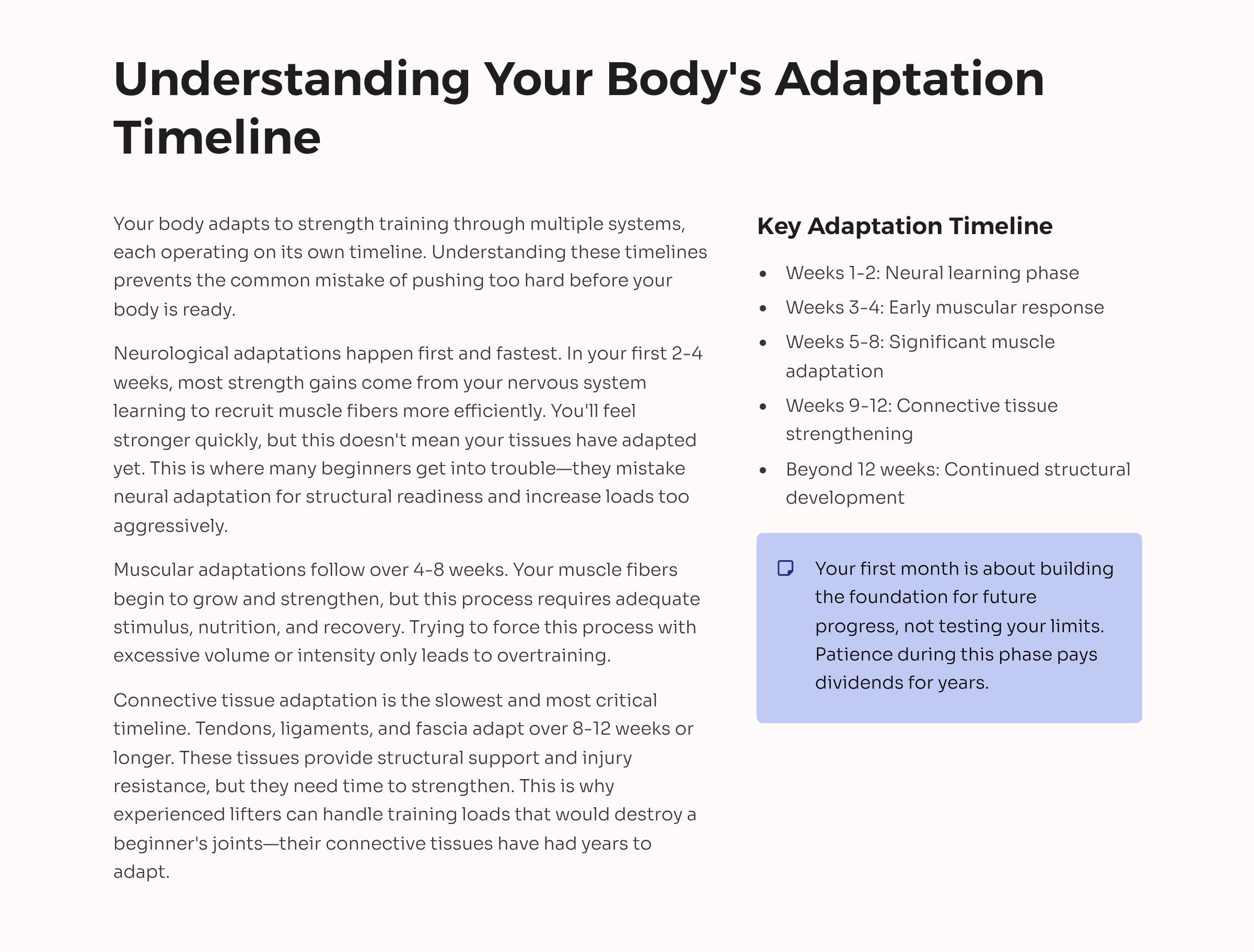
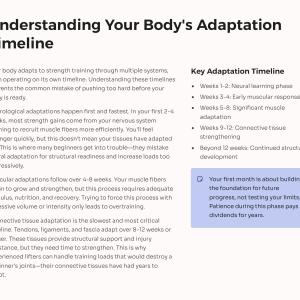
Part 1: Foundation and Mindset establishes the critical understanding that neurological adaptations happen in 2-4 weeks, muscular adaptations develop over 4-8 weeks, and connective tissue strengthening requires 8-12 weeks. This knowledge prevents the number one beginner mistake: increasing weight too quickly because you feel stronger before your tendons and ligaments have adapted.
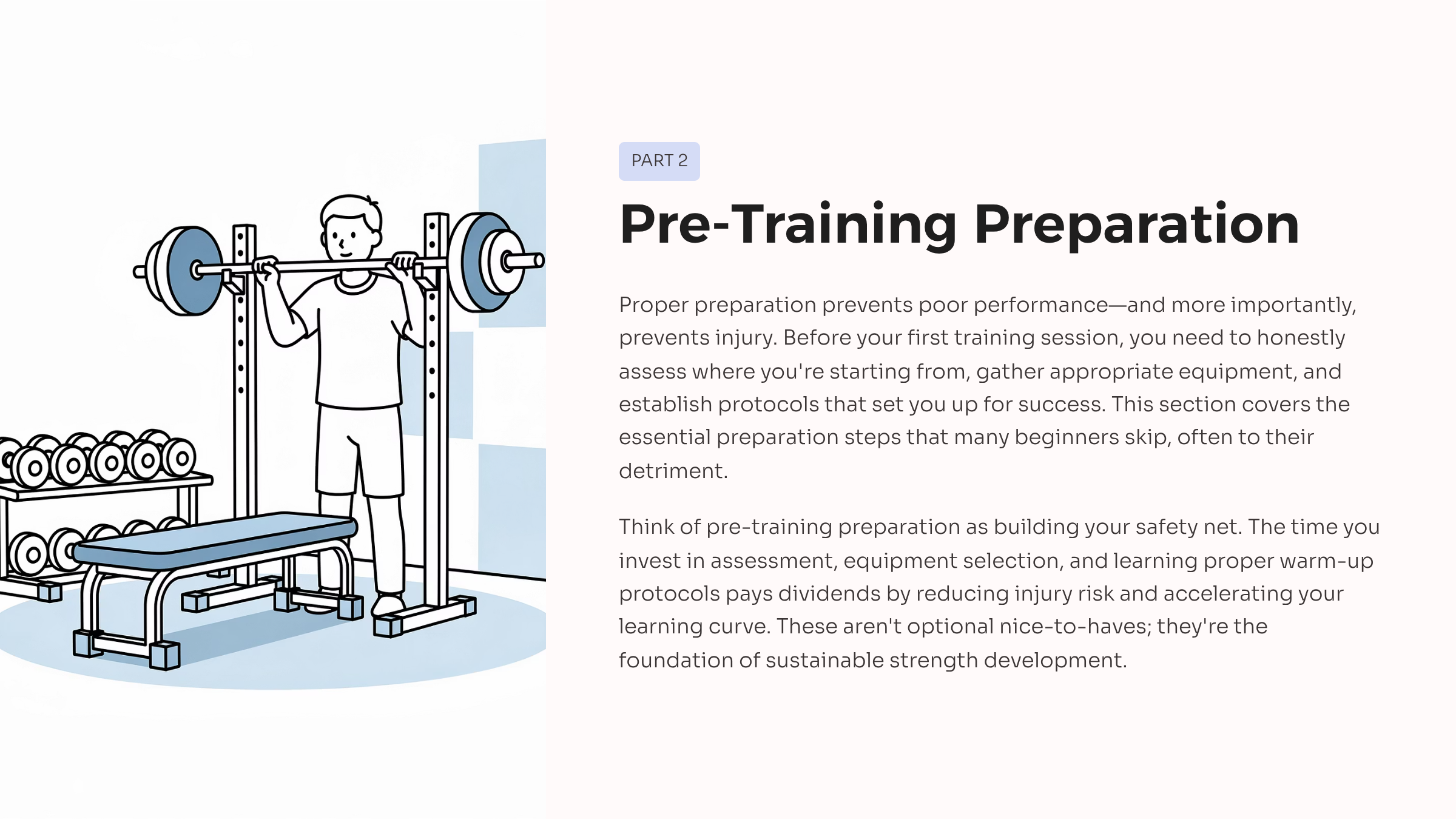
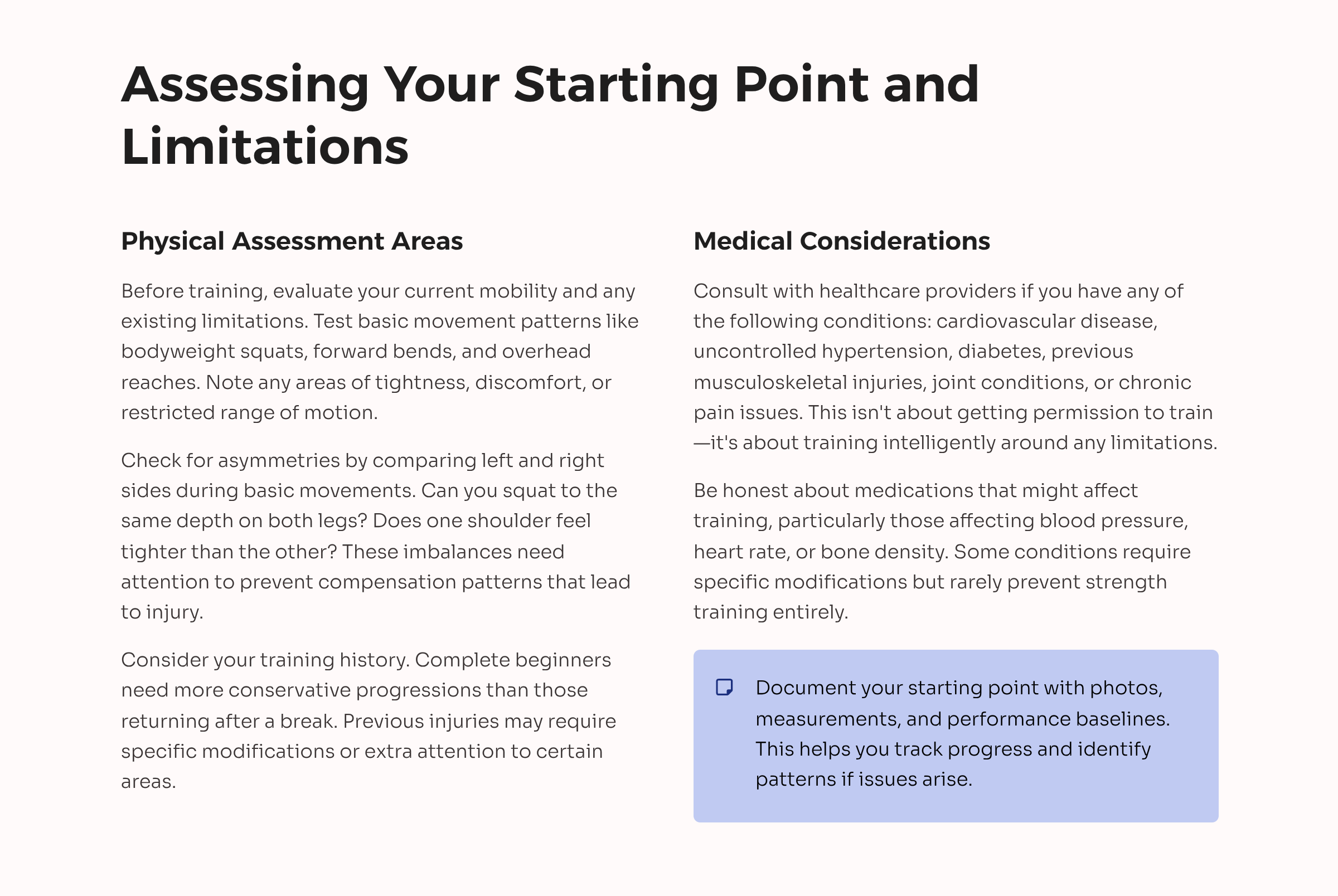
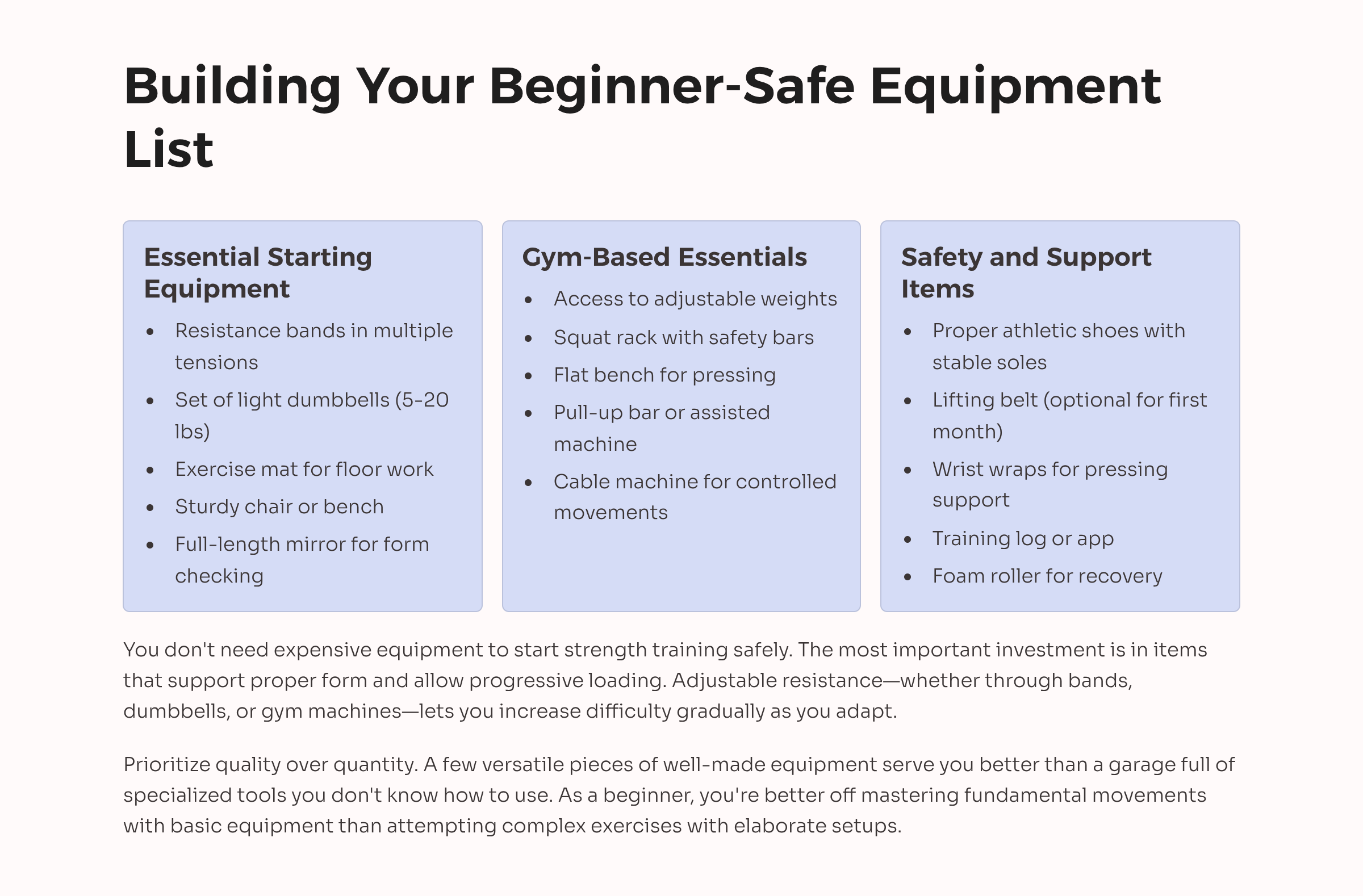
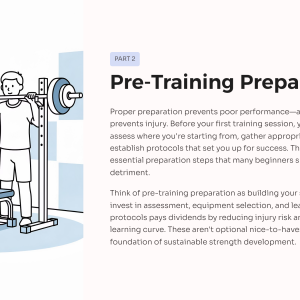
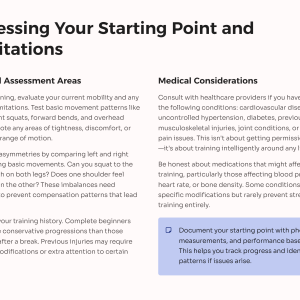
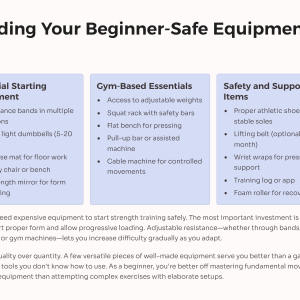
Part 2: Pre-Training Preparation provides physical assessment protocols, medical consideration guidelines, and equipment selection guidance. You’ll learn exactly how to evaluate your starting mobility, identify existing limitations, and choose the right training environment whether at home or in a gym.
Part 3: Mastering Foundational Movement Patterns breaks down six essential movement categories with detailed technical cues: bodyweight squats, hip hinges, push-up progressions, horizontal pulling, plank variations, and overhead movement fundamentals. Each pattern includes common mistake identification and correction strategies.
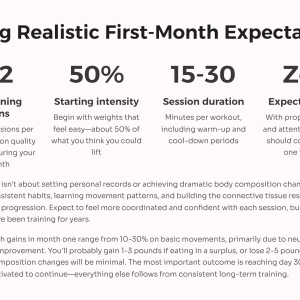
Part 4: Progressive Loading Strategies introduces the 50% Rule where you start with weights that feel almost comically light, allowing your body to adapt safely. Weekly progression guidelines specify adding only 5-10% to lower body exercises and 2.5-5% to upper body movements, with built-in deload weeks every fourth week to prevent accumulated fatigue.
Part 5: Exercise Execution and Form covers setup positioning, breathing techniques including the Valsalva maneuver for spinal protection, tempo training protocols, range of motion guidelines, and methods for spotting your own form breaks before they lead to injury.
Part 6: Recovery and Injury Prevention explains the 48-hour recovery rule, active recovery strategies, sleep and nutrition requirements for tissue repair, and the critical distinction between dynamic mobility work before training versus static stretching afterward.
Part 7: Your First Month Training Plan provides week-by-week programming with three training sessions per week, specific exercise selections, set and rep schemes, and progression criteria. Week 1 focuses on movement pattern learning with minimal weight, Week 2 adds resistance safely, Week 3 builds consistency, and Week 4 offers assessment and deload protocols.
Part 8: Warning Signs and Pain Management teaches you to identify the five red flags that mean stop immediately: sharp stabbing pain, painful joint grinding, radiating symptoms, progressive pain that worsens each session, and functional impairment. The 24-hour pain test provides a systematic framework for deciding whether discomfort is normal soreness or a developing injury.
How Key Ingredients Work: The Science Behind Safe Progression
The strength training methodology in this guide works by respecting your body’s natural adaptation timelines rather than fighting against them. When you begin lifting weights, your nervous system adapts first, teaching your brain to recruit muscle fibers more efficiently. This happens within 2-4 weeks and explains why you feel dramatically stronger so quickly.
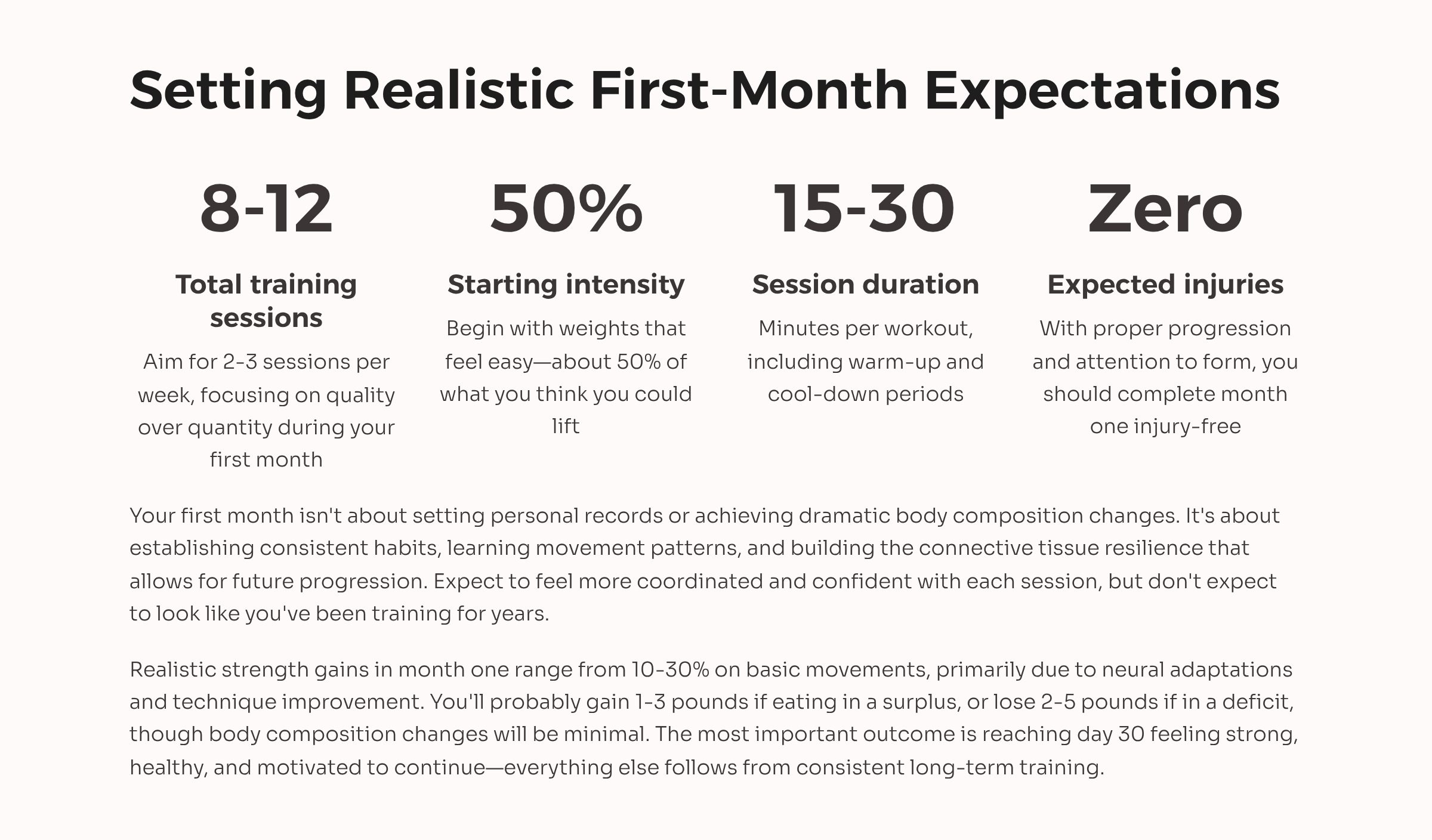
However, this rapid neural adaptation creates a dangerous trap. Beginners mistake neural strength gains for structural readiness and increase weights too aggressively, long before their tendons, ligaments, and fascia have had time to strengthen. These connective tissues require 8-12 weeks or longer to adapt, which is why the program starts at 50% of perceived capacity and progresses in tiny 5-10% increments.
The progressive overload system works by providing consistent stimulus without exceeding your recovery capacity. You challenge your muscles enough to drive adaptation but stop well short of the mechanical failure that damages tissues faster than they can repair. Training at RPE 5-7 and maintaining RIR 3-5 ensures you accumulate training volume without accumulating injury risk.
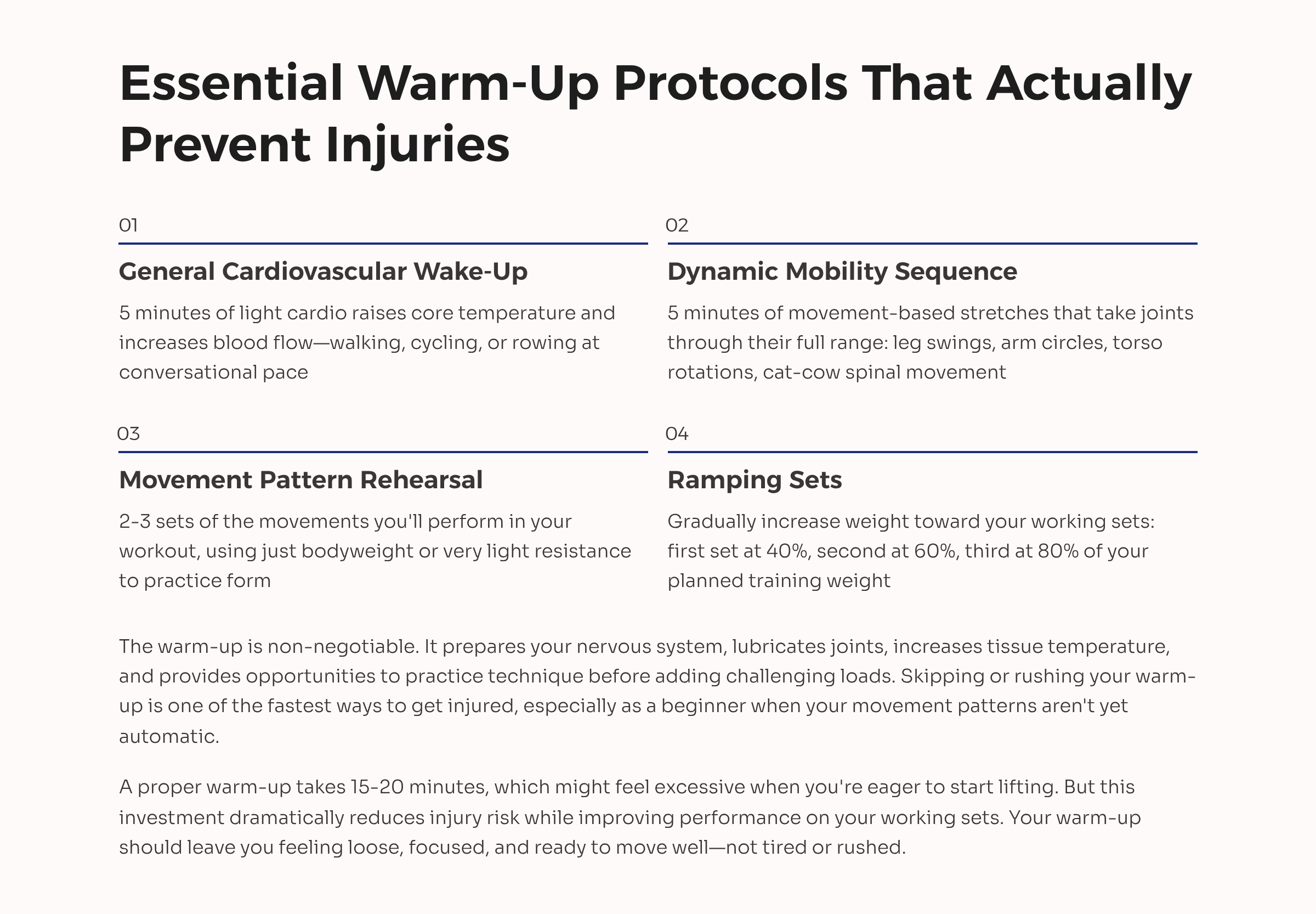
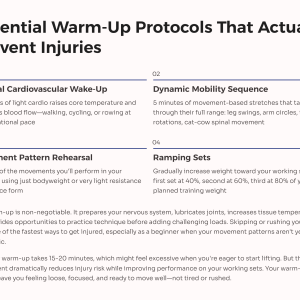
The warm-up protocols function as both injury prevention and performance enhancement. The three-phase system raises core temperature, lubricates joints, rehearses movement patterns, and allows neural activation before challenging loads. This 15-minute investment dramatically reduces injury risk while improving the quality of your working sets.
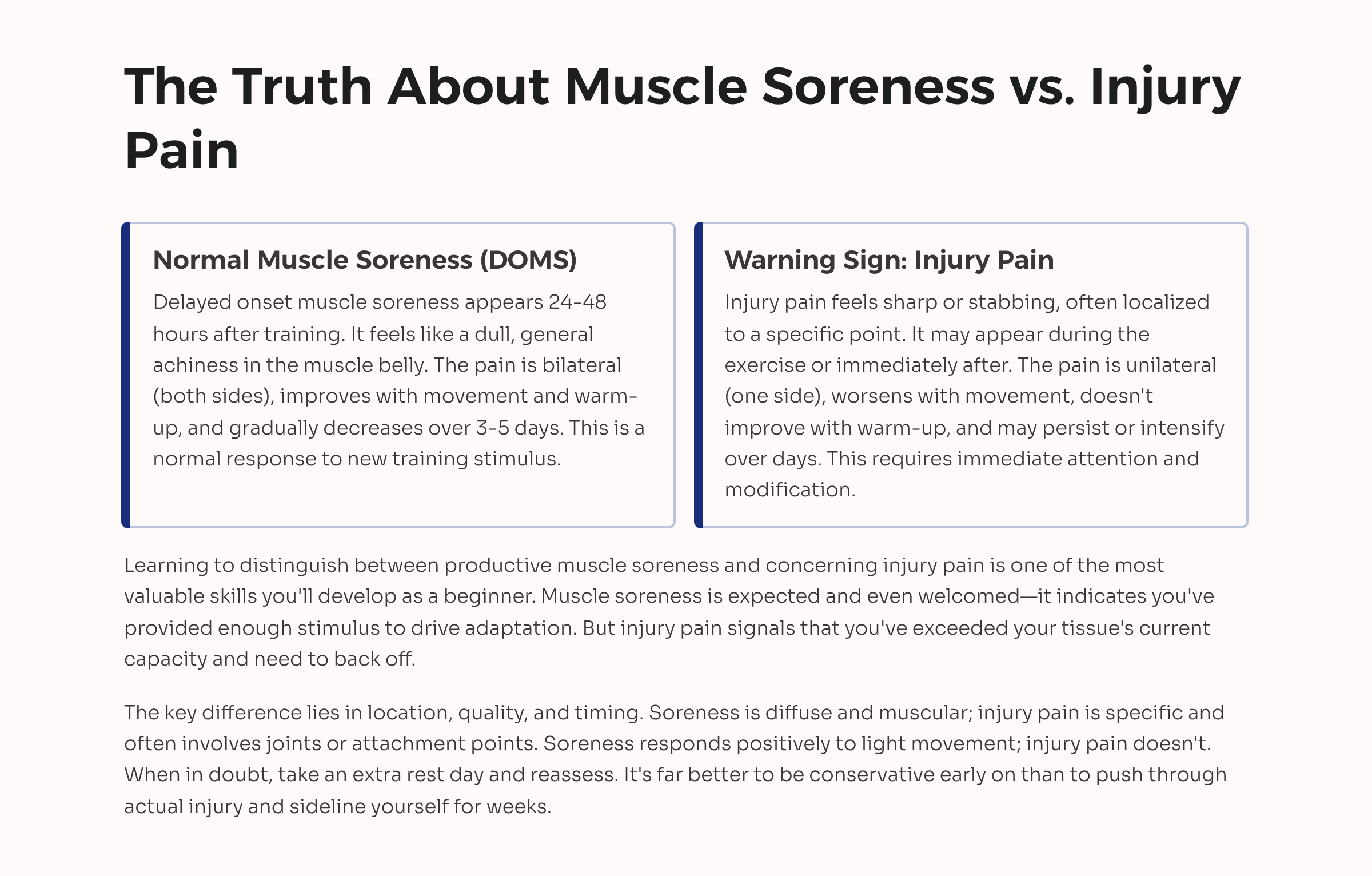
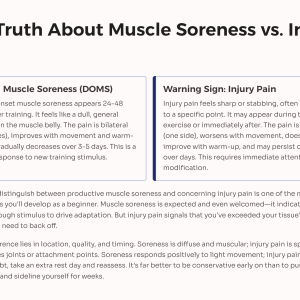
The pain differentiation framework works by teaching you specific characteristics that distinguish productive muscle soreness from injury signals. Normal DOMS appears 24-48 hours post-workout, feels dull and diffuse in the muscle belly, improves with movement, and resolves within 5-7 days. Injury pain feels sharp and localized, appears during or immediately after exercise, worsens with movement, and persists beyond one week. This knowledge empowers you to train confidently through normal discomfort while respecting genuine warning signs.
Specific Dosage and Usage Instructions
Week 1 Protocol: Complete three training sessions with minimum 48 hours between each session. Use bodyweight or very light resistance for all movements. Perform 3 sets of 10-12 repetitions per exercise with 2-3 minutes rest between sets. Exercise selection covers goblet squats, hip hinges with dowel, push-ups at appropriate progression level, inverted rows, planks for 20-40 seconds, and overhead press with light dumbbells. Total session duration including warm-up and cool-down is 45-60 minutes.
Week 2 Protocol: Maintain three sessions per week with same exercise selection. Add minimal resistance: 5-10 pounds to goblet squats, light dumbbells for hip hinges, advance push-up progression one level, add light resistance for rows. Continue 3 sets of 10-12 reps maintaining RPE 5-6, meaning you could do significantly more reps if needed.
Week 3 Protocol: Increase weights by 5-10% on lower body exercises and 2.5-5% on upper body movements. This typically means adding 5-10 pounds to squats and hip hinges, 2.5-5 pounds to pressing and pulling movements. If you cannot make these small jumps with available equipment, increase repetitions from 10 to 12 instead. Target RPE 6-7 with 3 sets per exercise.
Week 4 Protocol: If Weeks 1-3 went well with good form, consistent training, and adequate recovery, complete a light deload week by dropping back to Week 2 weights, reducing to 2 sets per exercise, and focusing on movement quality. If Weeks 1-3 were inconsistent or challenging, repeat Week 3 programming to solidify foundations before progressing to month two.
Daily Warm-Up Sequence: Invest 15 minutes before every training session: 5 minutes easy cardiovascular activity at conversational pace, 5 minutes dynamic mobility including leg swings, arm circles, torso rotations, and cat-cow spinal movements, 5 minutes movement pattern rehearsal performing bodyweight versions of working exercises for 2 sets of 8-10 reps each.
Recovery Guidelines: Allow minimum 48 hours between sessions targeting the same muscle groups. Consume 0.7-1 gram of protein per pound of bodyweight daily distributed across meals. Sleep 7-9 hours nightly as this is when growth hormone secretion peaks and tissue repair accelerates. Implement active recovery on non-training days with 20-30 minutes of easy walking, light swimming, or gentle yoga.
Key Features and Benefits
This strength training guide delivers transformation through systematic progression that keeps you injury-free while building real strength. The program eliminates guesswork by providing exact exercise selections, specific weight progression formulas, and clear decision-making frameworks for every scenario you’ll encounter.
Comprehensive Movement Pattern Library: Master six fundamental patterns that form the foundation of all strength exercises. Detailed breakdowns of bodyweight squats, hip hinges, push-up progressions, horizontal rows, plank variations, and overhead movements ensure you develop proper mechanics before adding significant resistance.
Pain Differentiation System: Learn to distinguish normal muscle soreness from injury signals using specific characteristics of location, quality, timing, and movement response. The 24-hour pain test provides a systematic framework for evaluating concerning discomfort and deciding whether to modify training or seek professional assessment.
Personalized Progression Model: The 50% Rule and conservative 5-10% weekly increases ensure your connective tissues adapt alongside your muscles. Built-in deload weeks every fourth week allow full recovery and prevent the accumulated fatigue that leads to overtraining or burnout.
Complete Four-Week Training Plan: Receive detailed session-by-session programming with specific exercise selections, sets, repetitions, rest periods, and progression criteria. Video recording guidelines and form check protocols help you maintain technique quality as weights increase.
Extensive Troubleshooting Section: Address common first-month challenges including excessive muscle soreness, difficulty achieving proper squat depth, lower back discomfort, inconsistent scheduling, asymmetrical strength development, and performance plateaus. Each problem includes practical solutions that keep you training safely.
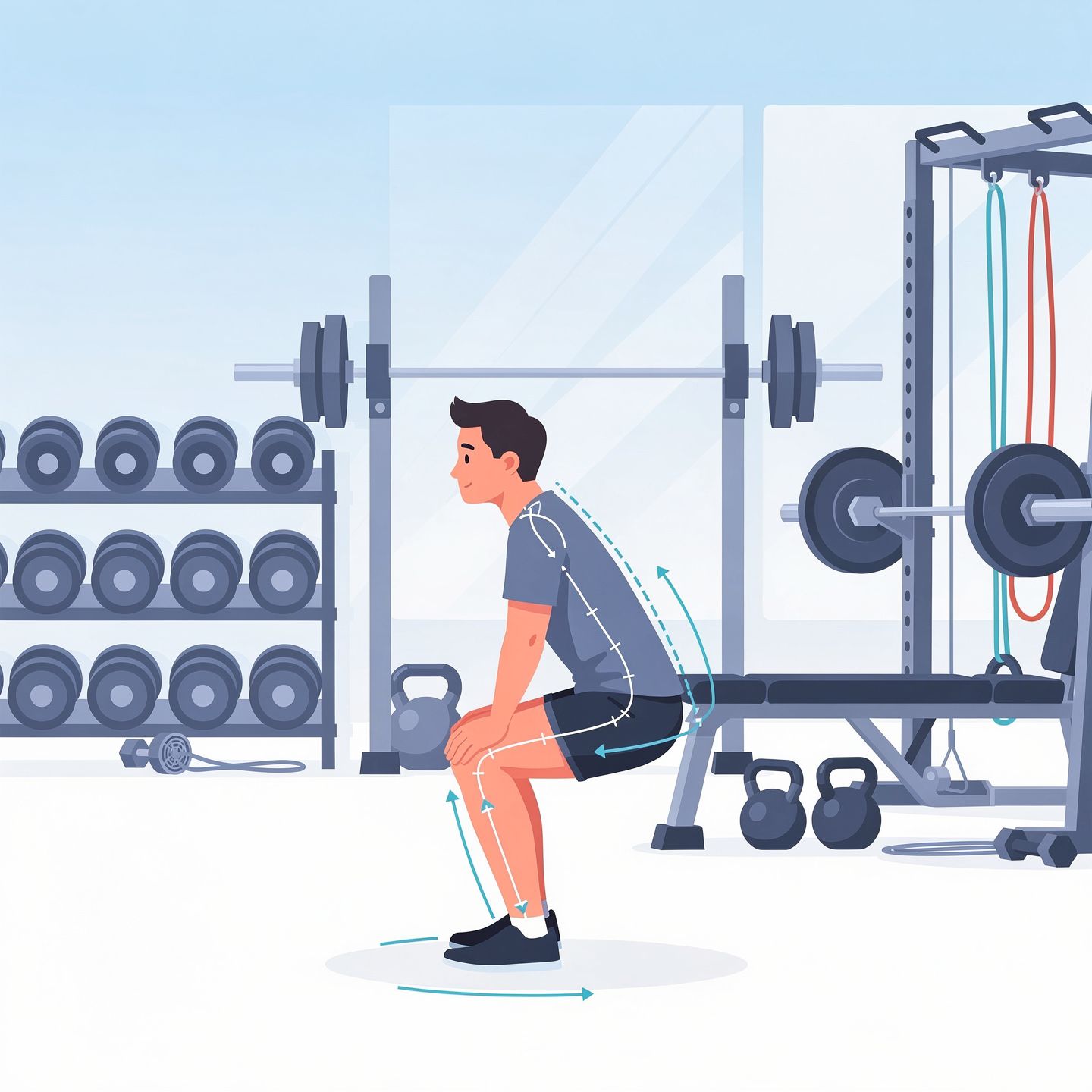
Visual Learning Aids: Detailed diagrams show correct versus incorrect form for major movements, pain assessment charts distinguish safe zones from danger zones, and weekly progression summaries provide at-a-glance reference for training decisions.
Quick Reference Guides: One-page action plan summarizes essential training session structure, weekly progression guidelines, and the eight critical principles that prevent injury. Tear-out style reference cards allow convenient access during actual workouts.
Addressing Your Biggest Pain Points
The fear of injury keeps countless people from starting strength training despite wanting the benefits of increased muscle mass, stronger bones, and improved metabolic health. This guide directly addresses that fear by teaching you exactly what normal discomfort feels like versus what injury signals require immediate attention.
You’ll learn the five red flags that mean stop immediately: sharp stabbing pain, painful joint grinding or popping, radiating pain that travels from one area to another, progressive pain that worsens with each session, and functional impairment severe enough to alter daily activities. When you can recognize these signals early, you prevent minor issues from becoming major injuries that sideline you for months.
The embarrassment many beginners feel at the gym stems from not knowing proper technique and worrying about looking incompetent in front of experienced lifters. This strength training system eliminates that anxiety by ensuring you master movement patterns with bodyweight and light resistance before progressing to challenging loads. You’ll develop genuine competence through systematic practice rather than faking your way through exercises you don’t understand.
The loss of motivation that derails fitness goals happens when progress feels invisible or when setbacks create the perception that effort isn’t worth the reward. This program structures progress in measurable increments with weekly assessments that demonstrate concrete improvement. You’ll track not just weight lifted but movement quality, coordination, body awareness, and consistency. These non-scale victories sustain motivation even when physical changes develop gradually.
The confusion about whether you’re pushing hard enough or pushing too hard disappears when you understand RPE scales and RIR guidelines. Target RPE 5-7 for most sets means the effort feels moderate to challenging but manageable, with 2-3 reps remaining before technical failure. This sweet spot provides adequate stimulus for adaptation without the excessive fatigue or injury risk of training to complete failure.
Why Generic Solutions Fail You
Most fitness advice provides one-size-fits-all recommendations that ignore individual differences in mobility, training history, recovery capacity, and biomechanics. A program designed for someone returning to training after a break differs dramatically from what an absolute beginner needs, yet generic plans treat all beginners identically.
The lack of personalized progression plans means you don’t know whether to add weight weekly, biweekly, or monthly. You don’t know whether soreness indicates productive training or excessive volume. You don’t know if your squat depth limitations stem from ankle mobility, hip mobility, or anatomical factors. Without this specific guidance, you either progress too conservatively and waste time, or too aggressively and get injured.
The inability to distinguish between productive muscle soreness and injury signals causes beginners to either push through actual injuries thinking they’re building toughness, or avoid all discomfort and never provide adequate training stimulus. Both approaches prevent progress. This guide teaches you specific characteristics that differentiate DOMS from concerning pain, including location, quality, timing, and response to movement and warm-up.
The emotional impact of injury, embarrassment, and lost motivation compounds when you lack community, expert guidance, and troubleshooting frameworks. When challenges arise and you don’t know whether they’re normal or problematic, anxiety takes over. This program provides extensive troubleshooting for every common first-month challenge so you always have solutions rather than spiraling into doubt and quitting.
Transform Your Relationship With Strength Training
Imagine walking into the gym four weeks from now with genuine confidence rather than anxiety. You understand proper form on fundamental movements. You can distinguish normal training discomfort from warning signs that require modification. You’ve built sustainable habits through consistent twice or thrice weekly training sessions. You’ve made measurable progress without a single injury.
That transformation happens when you follow a system designed specifically for absolute beginners who want to build strength without the pain, fear, and confusion that derail so many new lifters. This strength training guide provides everything you need: assessment protocols, detailed exercise instruction, progressive loading formulas, recovery guidelines, troubleshooting solutions, and structured programming for your critical first month.
Your partner will notice the change too. The newfound confidence from mastering challenging physical skills. The improved posture from balanced pushing and pulling movements. The reduced stress from consistent exercise and the endorphin release that accompanies training. The positive momentum from achieving tangible progress through disciplined effort. These benefits extend far beyond the gym into every aspect of your life.
Take Action Now and Start Building Strength Safely
The foundation you build in your first month of strength training determines whether you progress safely for years or cycle through injury and frustration. Every day you delay is another day your bones aren’t being strengthened, your muscles aren’t adapting, and your confidence isn’t growing. The best time to start was months ago. The second best time is today.
This comprehensive guide eliminates the barriers that stop most people from starting. You don’t need to hire an expensive personal trainer or figure everything out through trial and error. You don’t need to risk injury by copying what you see others doing at the gym. You don’t need to remain paralyzed by fear of doing something wrong. Everything you need to start safely and progress systematically is contained in this proven program.
Your future self will thank you for the patience and discipline you demonstrate today. The athletes who train successfully for decades aren’t those who pushed hardest in their first month. They’re those who built proper foundations through conservative progression, perfect practice, and respect for their body’s adaptation timelines. That’s exactly what this strength training system teaches you to do.
Stop letting fear and confusion keep you from the strength, confidence, and vitality you deserve. Get started now with a program designed specifically to keep beginners injury-free while building real, lasting results.








Reviews
There are no reviews yet.