
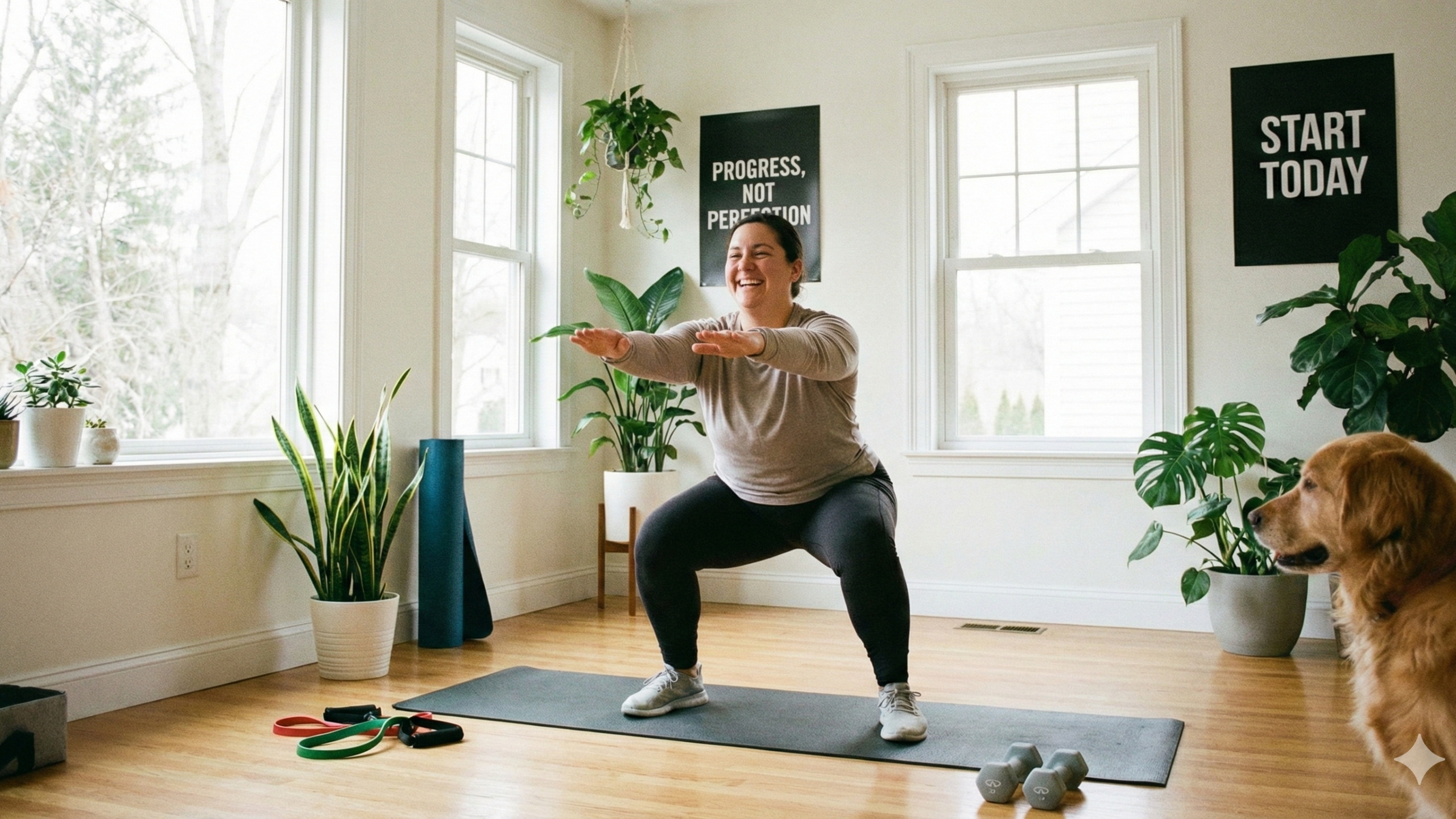
Stepping into the world of fitness can feel like navigating uncharted territory—overwhelming, uncertain, and sometimes even intimidating. But what if the secret to transformation isn’t found in complex regimens or punishing workouts, but in the elegant simplicity of Beginner Routines? These foundational practices are the gentle doorway to a stronger, more vibrant you.
Forget about grand gestures or overnight miracles; Beginner Routines are about cultivating consistency, building confidence, and discovering the subtle art of progress. Each movement, each breath, becomes a stepping stone toward lasting change. Whether you’re carving out time in a hectic schedule or simply seeking a spark of Motivation, Beginner Routines offer a practical, sustainable approach that welcomes all fitness levels.
They’re not just exercises—they’re rituals that nurture both body and mind. Imagine starting with small, manageable steps that gradually unfold into a life of vitality. No perfection required, just presence. With Beginner Routines, every session is a victory, every effort a triumph. This is your invitation to begin, to explore, and to embrace the journey—one simple step at a time.
What Are Beginner Routines and Why Do They Matter
In an era of high-intensity interval training, complex powerlifting splits, and 75-day complicated challenges, the concept of a “Beginner Routine” can feel unexciting. However, a beginner routine is the single most critical tool in a fitness journey.
A beginner routine is a structured, low-barrier plan that prioritizes adherence over intensity. It matters because it is the foundation upon which a lifetime of health is built. Without this foundation, advanced protocols usually lead to burnout or injury.
Why Starting Simple Makes All the Difference
The biggest mistake new fitness enthusiasts make is trying to optimize everything on day one. They change their diet, sleep schedule, and workout intensity simultaneously. This is a recipe for failure.
Starting simple works because of Psychological Safety and Friction Reduction:
- Low Barrier to Entry: When a workout requires learning 10 complex movements, the brain perceives it as a threat or a chore. When a routine consists of three basic movements (e.g., Squat, Push-up, Walk), the mental friction disappears.
- Confidence Building: Simple routines allow for quick mastery. Feeling competent (“I did that push-up correctly”) releases dopamine, which fuels the desire to do it again.
- Reduced Decision Fatigue: A simple routine removes the question “What should I do today?” You already know. This saves your willpower for the actual work.
The Rule of Thumb: If you aren’t 90% sure you can complete the routine on your worst day, it is too complex.
Understanding the Power of Consistency
There is a misconception that results come from intensity—how much you sweat or how sore you are. In reality, physiological changes (muscle growth, cardiovascular health, fat loss) are adaptations to frequency.
Consistency signals the body to adapt.
- The Compound Effect: One workout does nothing. Ten workouts do very little. One hundred workouts transform a physique. Beginner routines are designed to get you to workout #100 by ensuring you don’t quit at workout #10.
- Discipline > Motivation: Motivation is an emotion; it is fleeting. Consistency is a habit. Beginner routines rely on consistency because they are manageable even when motivation is low.
How Beginner Routines Build Long-Term Fitness Habits
A habit is formed through a loop: Cue $\rightarrow$ Routine $\rightarrow$ Reward.
Beginner routines are specifically designed to hack this loop:
- The Cue: Because the routine is simple, it can be easily attached to an existing habit (e.g., “After I brush my teeth, I do my stretching routine”).
- The Routine: Because the physical demand is manageable, the brain doesn’t resist the action phase.
- The Reward: Because you completed it successfully without pain or excessive struggle, you feel a sense of accomplishment (intrinsic Reward).
Over time, this repetition rewires neural pathways. You stop being “someone who is trying to work out” and start becoming “someone who works out.” This is an identity shift, and it is the only way to maintain fitness for decades rather than months.
Setting Realistic Expectations for Newcomers
The gloss of a new routine usually fades after two weeks. This is where expectations make or break the journey. A solid beginner mindset accepts the following truths:
- The “Dip” is Coming: There will be a period when the novelty wears off, but the physical results haven’t yet shown up. This is the “Valley of Disappointment.” Sticking with the routine through this valley is the only Goal.
- Non-Scale Victories: Beginners should ignore the scale for the first 60 days. Instead, track:
- Energy levels: Do you feel less sluggish in the afternoon?
- Mobility: Is it easier to tie your shoes or carry groceries?
- Sleep quality: Are you resting better?
- Progression is Non-Linear: You will have bad days. A beginner routine accommodates this by being flexible. Missing one day does not ruin the plan; quitting because you missed one day does.
The Science Behind Starting Small
Starting small is not a concession to laziness; it is a strategic alignment with human biology. When we attempt massive lifestyle changes overnight, we fight against our body’s desire for homeostasis—the physiological process that seeks to maintain stability. By keeping changes small, we fly under the body’s “radar,” allowing new behaviors to take root before the brain attempts to resist them.
The Psychology of Motivation for Beginners
Motivation is unreliable.1 It is a fluctuating emotion, not a character trait.2 Relying on it to drive complex new behaviors is scientifically unsound. To understand why starting small works, we can look at the Fogg Behavior Model, developed by Dr. BJ Fogg at Stanford University.3+2
The model states that Behavior (4$B$) happens when three things converge: Motivation (5$M$), Ability (6$A$), and a Prompt (7$P$).8 The Formula is expressed as:
$$B = MAP$$
- The Inverse Relationship: When motivation is high, you can do hard things (low Ability). When motivation inevitably dips (e.g., after a long day at work), you can only perform easy actions (high Ability).
- The Beginner’s Advantage: By “starting small,” you are maximizing the Ability factor. You make the workout so easy that you can do it even when your motivation is near zero. This ensures the Behavior occurs consistently, regardless of your emotional state.
Why Quick Isn’t Always Necessary
We live in a world of instant gratification, but biological adaptation is a slow process. Chasing quick results often triggers a “boom and bust” cycle.
- The Plateau of Latent Potential: As illustrated by author James Clear, there is often a lag between the effort you put in and the visible results you see.9 This is the “Valley of Disappointment.” Beginners usually quit here because they don’t see immediate abs or weight loss.
- Physiological Adaptation: Your cardiovascular system adapts faster than your musculoskeletal system. If you ramp up intensity too quickly to get “quick results,” your muscles might handle the load, but your tendons and ligaments (which have less blood flow) cannot keep up. This leads to injury.
- The Paper Towel Analogy: Fitness is like a roll of paper towels. When the roll is complete, tearing off one sheet (one workout) is unnoticeable. It’s only after tearing off sheet after sheet over time that the roll (your body) clearly changes shape.
Key Takeaway: Slow progress is sticky. Rapid progress is often transient. The goal is not to cross the finish line quickly; it is to stay on the track forever.
Building Confidence Through Small Wins
In psychology, the belief in one’s abilitAbilitycceed in a specific situation is called Self-Efficacy.10 For a beginner, self-efficacy is usually low.
- The Dopamine Loop: Every time you complete a task, your brain releases dopamine—a neurotransmitter associated with pleasure and learning. This is a chemical reward.
- Rewiring the Brain: When you set a massive goal (e.g., “Run 5 miles”) and fail, you condition your brain to associate exercise with failure and pain. When you set a tiny goal (e.g., “Walk 5 minutes”) and succeed, you get a dopamine hit.
- Momentum: These “small wins” accumulate.11 Successfully sticking to a 5-minute routine for a week proves to yourself that you are capable of discipline. This confidence lowers the “activation energy” required to tackle harder workouts later. You are literally training your brain to trust your own promises.
Choosing the Right Type of Routine for You
The “perfect” workout program does not exist in a vacuum. The perfect program is simply the one you can stick to for six months or longer. Choosing a routine is not about finding the most scientifically optimal regimen; it is about finding the path of least resistance that aligns with your life.
Identifying Your Fitness Goals
Before picking up a weight or lacing up shoes, you must define the destination. A routine designed for marathon running will look vastly different from one designed for building muscle.
Beginners usually fall into one of three primary goal categories:
- Goal: Fat Loss & Health Management
- Focus: Calorie expenditure and heart health.
- Ideal Routine: A mix of steady-state cardio (walking, cycling) and basic resistance training to preserve lean mass while losing weight.
- Goal: Strength & Muscle Tone
- Focus: Progressive overload (gradually making things heavier or more complex).
- Ideal Routine: Resistance training (calisthenics/bodyweight, dumbbells, or machines) 2–3 times per week.
- Goal: Mobility & Pain Reduction
- Focus: Range of motion and joint stability.
- Ideal Routine: Yoga, Pilates, or a dedicated stretching and mobility flow.
Note: For absolute beginners, a “General Physical Preparedness” (GPP) approach—doing a little bit of everything—is often the best starting point to build a balanced base.
Matching Routines to Your Lifestyle
The most common reason for quitting is a mismatch between the routine and the reality of your daily life. A 6-day-a-week gym split is destined to fail if you work 60 hours a week and have two children.
Evaluate your constraints honestly using these three variables:
- Time Budget:
- 15–20 minutes: High-Intensity Interval Training (HIIT) or dense circuit training.
- 30–45 minutes: Standard strength training or steady jogging.
- 60+ minutes: Full gym sessions or long-distance endurance.
- Location Preference:
- Home: Eliminates commute time but requires self-discipline. Best for bodyweight routines or kettlebells.
- Gym: Provides environment and equipment, but adds travel friction. Best for heavy lifting.
- Outdoors: Best for mental health and cardio (running, hiking), but weather-dependent.
- Energy Cycles:
- Are you a morning lark or a night owl? Don’t schedule a 5:00 AM workout if you naturally stay up until midnight. Work with your biology, not against it.
How to Pick the Best Beginner-Friendly Activities
The best activities for beginners share three characteristics: Low Skill Requirement, High Scalability, and Low Injury Risk.
- Walking: The underrated king of fitness. It requires no equipment, can be done anywhere, and recovery is instant. It is the ultimate entry point for building a habit.
- Bodyweight Strength (Calisthenics): Squats, lunges, push-ups (on knees or wall if needed), and planks. These teach body awareness and lay the groundwork for weightlifting later.
- Machine-Based Resistance: If you join a gym, machines are excellent for beginners because they stabilize the movement path for you, reducing the risk of dropping weights or using poor form.
- Swimming or Cycling: “Low impact” options that are easier on the joints than running, making them ideal for those carrying extra weight or managing previous injuries.1
The Golden Rule: Pick the activity you hate the least. If you enjoy it, that’s a bonus. If you can merely tolerate it, that is sufficient for success.
Essential Components of Every Beginner Routine
A random collection of exercises is just a workout; a structured sequence of components is a routine. For beginners, structure is safety. Every session, regardless of the activity, should follow a logical arc: prepare the body, perform the work, and recover.
Warm-Up: The Key to Injury Prevention
Many beginners skip the warm-up to save time, viewing it as optional “fluff.” This is the leading cause of early strains and sprains.
Think of your muscles like a rubber band. If you pull a cold rubber band, it snaps. If you warm it up by rubbing it between your hands, it becomes elastic and pliable.
- Physiological Goals: A warm-up is designed to raise your core body temperature, increase blood flow to the muscles, and lubricate the joints with synovial fluid.
- Dynamic vs. Static: Beginners often mistake stretching for warming up.
- Avoid: Static stretching (holding a position for 30 seconds) before a workout. This can actually temporarily weaken the muscle.
- Do: Dynamic movements. These are active movements that mimic the workout you are about to do.
- Examples:
- Leg swings and lunges before running.
- Arm circles and wall push-ups before upper body strength training.
- Bodyweight squats before weighted squats.
The Importance of Stretching
While dynamic movement belongs at the start, static stretching belongs at the end. Once the workout is complete, the muscles are warm and exhausted, making this the safest time to lengthen them.
- The Cool-Down: Stretching signals your nervous system to shift from “fight or flight” (sympathetic state) back to “rest and digest” (parasympathetic state). It gradually lowers the heart rate.
- Long-Term Mobility: Fitness tightens muscles. Strength training contracts them; running shortens the hamstrings. Without stretching, this tightness accumulates over months, leading to poor posture and reduced range of motion.
- Recovery: Gentle stretching improves circulation, which helps flush out metabolic waste products (like lactate) accumulated during exercise, potentially reducing soreness the next day.
Beginner Tip: Aim to hold post-workout stretches for 30–60 seconds. Breathe deeply; if you are holding your breath, you are stretching too hard.
Building a Balanced Routine: Cardio, Strength, and Flexibility
A common pitfall is becoming “fitness exclusive”—doing only cardio (runners who have no upper body strength) or only lifting (lifters who get winded climbing stairs). A true beginner routine builds a complete foundation by balancing three pillars:
- Cardiovascular Health (The Engine):
- Role: Strengthens the heart and lungs, burns calories, and improves endurance.
- Frequency: Can be done most days (e.g., walking) or 2–3 times a week (jogging/cycling).
- Strength Training (The Chassis):
- Role: Preserves muscle mass, strengthens bones (critical for aging), and boosts metabolism.
- Frequency: 2–3 times per week. Beginners should leave at least 48 hours of rest between strength sessions for the same muscle groups.
- Flexibility & Mobility (The Suspension):
- Role: Ensures joints move through their full range of motion without pain.
- Frequency: ideally daily, but critically after every workout.
The “2Formula:
For a simple, balanced weekly schedule, try:
- 2 Days of Strength (e.g., Mon/Thu)
- 2 Days of Cardio (e.g., Tue/Fri)
- 1 Day of Active Recovery/Flexibility (e.g., Sat – Yoga or long walk)
- 2 Days of Rest
Step 1: Start with a Simple Warm-Up
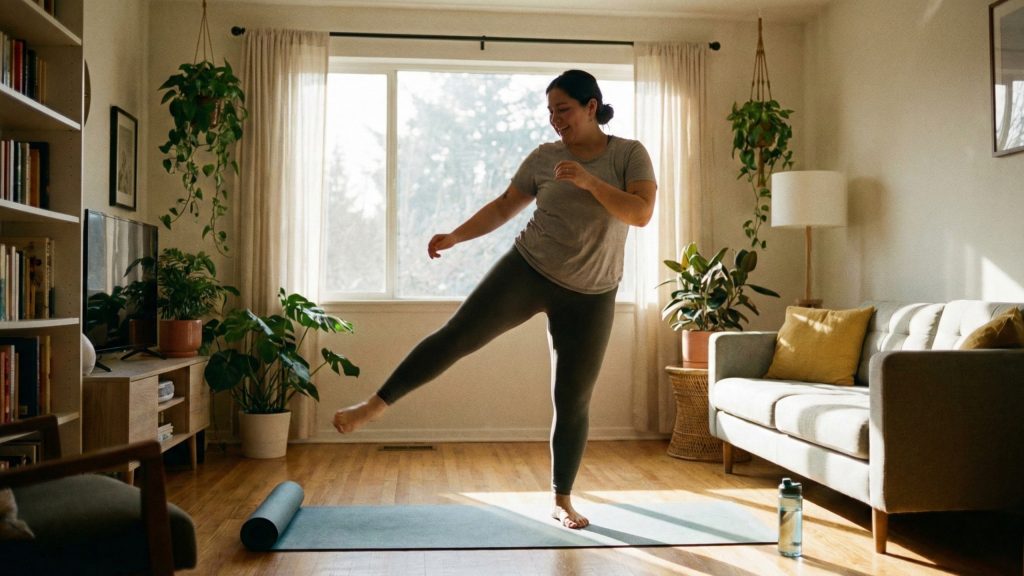
Step 2: Focus on Bodyweight Exercises
Why Bodyweight Moves Are Perfect for Beginners
For a beginner, the gym floor can be an intimidating landscape of complex machines and heavy iron. Bodyweight training (calisthenics) removes these barriers, stripping fitness down to its most essential element: you and gravity.1
- Zero Friction: The “gym” is wherever you are standing. You can work out in your living room, a hotel room, or a park.2 This eliminates the “I don’t have time to drive to the gym” excuse.3+1
- Proprioception (Body Awareness): Before you can safely control a heavy barbell, you must learn to control your own limbs in space. Bodyweight training teaches you how to stabilize your core and coordinate movement patterns without the risk of external weights crushing you.4
- Self-Limiting Safety: It is easier to injure yourself with bodyweight exercises than with heavy lifting.5 If you are not strong enough to do a push-up, gravity lowers you to the floor; you don’t get stuck under a bar.
Sample Bodyweight Exercises for Newcomers
A complete bodyweight routine covers the major movement patterns: pushing, pulling, squatting, and hinging. Here is a starter menu of exercises:
- Lower Body:
- Squat: The king of leg exercises.6 Targets quads, hamstrings, and glutes.7+1
- Glute Bridge: Targets the posterior chain (back of legs and butt) without straining the lower back.8
- Reverse Lunge: Safer for knees than forward lunges; excellent for balance.9
- Upper Body:
- Push-Up: The gold standard for chest, shoulders, and triceps.10
- Doorframe Row: A simple pulling motion using a sturdy doorframe to work the back muscles (often neglected in home workouts).11
- Core:
- Plank: Builds stability by teaching you to brace your stomach muscles.
- Dead Bug: A lying-down movement that strengthens the core while protecting the spine.
How to Perform Squats, Lunges, and Push-Ups Safely
Form is everything. A sloppy rep is not just ineffective; it is a rehearsal for injury. Here is how to execute the “Big Three” safely.
1. The Bodyweight Squat
- The Stance: Stand with feet shoulder-width apart or slightly wider. Toes can point slightly outward (about $15^\circ$ to $30^\circ$).
- The Descent: Initiate the movement by pushing your hips back first, as if you are reaching for a chair behind you. Then, bend the knees.
- The Depth: Go as low as you can while keeping your heels flat on the floor and your chest up.
- The Safety Check: ensure your knees track in line with your toes. Do not let your knees cave inward toward each other (valgus collapse).
2. The Reverse Lunge
- The Setup: Stand tall with feet together.
- The Step: Take a long step backward with one foot. Lower your hips until both knees form roughly $90^\circ$ angles. The back knee should hover just above the floor.
- The Safety Check: Keep your torso upright—imagine balancing a book on your head. Ensure your front knee does not shoot excessively far past your toes, and keep the weight in the mid-foot/heel of the front leg.
3. The Push-Up (and Modifications)
- The Setup: Place hands on the floor slightly wider than shoulder-width. Extend legs back so you are in a high plank position.
- The Line: Your body should form a straight line from head to heels. Squeeze your glutes and brace your abs to prevent your hips from sagging.
- The Elbows: As you lower yourself, tuck your elbows back at a $45^\circ$ angle (making an arrow shape with your body), rather than flaring them out to the sides (creating a ‘T’ shape). This protects the shoulders.
- The Modification: If a floor push-up is too hard, do Incline Push-Ups. Place your hands on a couch, bench, or sturdy table. The higher the surface, the easier the movement. This is preferred over “knee push-ups” because it teaches better full-body tension.
Step 3: Add Short Cardio Bursts
Once you have established a baseline of movement and strength, the next layer is cardiovascular health. Cardio isn’t just about burning calories; it is about training your heart—the most important muscle in your body—to pump blood more efficiently.1
The Benefits of Cardio for Beginners
For a beginner, the word “cardio” often conjures images of gasping for air on a treadmill. However, appropriate cardio training offers immediate and profound benefits without requiring extreme suffering:
- Heart Efficiency: Regular cardio lowers your resting heart rate.2 A stronger heart pumps more blood per beat, meaning it doesn’t have to work as hard when you are resting.3+1
- Mitochondrial Density: Cardio increases the number of mitochondria (power plants) in your cells.4 This leads to increased energy levels throughout the day, not just during workouts.
- Mood Regulation: Aerobic exercise is one of the most effective natural ways to reduce cortisol (stress hormone) and release endorphins, often referred to as the “runner’s high”—even if you’re walking briskly.
- Recovery: Light cardio increases blood flow, which helps flush out metabolic waste from sore muscles, speeding up recovery from strength training.5
Easy Cardio Activities to Try at Home
You do not need a treadmill, an elliptical, or even running shoes to get a great cardio workout. “Home Cardio” focuses on elevating the heart rate using your own body weight.6
Here are accessible options, ranked by intensity:
- Marching in Place (Low Intensity):
- How: Lift your knees high and pump your arms rhythmically.
- Why: Great for absolute beginners or those with joint issues. It gets the blood moving with zero impact.
- The “Invisible Jump Rope” (Medium Intensity):
- How: Bounce lightly on the balls of your feet while rotating your wrists as if holding a rope.
- Why: distinct from high-impact jumping, this keeps the hops small and controlled, building calf strength and coordination.
- Step-Ups (Medium Intensity):
- How: Use a sturdy bottom stair. Step up with one foot, bring the other up, then step down. Alternate legs.
- Why: mimics hiking and builds functional stamina.
- Mountain Climbers (High Intensity):
- How: Start in a plank position. Drive one knee toward your chest, then switch quickly.
- Why: A full-body metabolic torch that works the core and shoulders while spiking the heart rate.
How to Gradually Increase Intensity
The Goal is to stimulate the heart, not explode it. Beginners should use the concept of Progressive Overload for cardio just as they would for weights.
- Use the “Talk Test”:
- Zone 2 (Moderate): You should be breathing heavier than usual but still able to hold a conversation. This is the “sweet spot” for building a base.
- Zone 4 (Vigorous): You can only speak a few words at a time. Save this for short bursts only.
- Increase Duration First, Intensity Second:
- Week 1: Perform cardio for 30 seconds, rest for 30 seconds.
- Week 2: Perform cardio for 40 seconds, rest for 20 seconds.
- Don’t run faster; just run longer.
- Reduce Rest Intervals:
- As you get fitter, your heart rate recovers faster.7 If you used to need 60 seconds to catch your breath, try cutting it to 45. This increases the “density” of the workout without making the movements harder.
Step 4: Incorporate Flexibility and Mobility
While strength training builds the engine and cardio improves the fuel lines, flexibility and mobility act as the suspension system. For a beginner, neglecting this component is the fastest route to chronic aches, poor posture, and eventual injury. Understanding the nuance between these two concepts and integrating them into your routine is essential for long-term functional health.
Why Flexibility Matters for New Exercisers
Many newcomers view stretching as an optional afterthought—something to do only if there is extra time. However, as you begin to stress your muscles through new exercises, the tissue naturally shortens and tightens as it recovers. Without intervention, this leads to a gradual loss of range of motion.
It is crucial to distinguish between flexibility and mobility, as they serve different roles:
- Flexibility is the passive abilitAbilitymuscle to lengthen (e.g., how far you can pull your leg back with your hands).
- Mobility is the active Ability to control a joint through a range of motion (e.g., how high you can lift your leg using only your hip muscles).
For beginners, improved mobility matters for three primary reasons:
- Mechanical Efficiency: Tight hip flexors (often caused by sitting all day) inhibit the glutes from firing correctly during a squat. If your joints can move freely, you perform exercises with better form, leading to better results.
- Pain Management: Much of what we perceive as “bad knees” or a “bad back” is actually a referred issue caused by tightness elsewhere. For example, tight ankles often force the knees to take on excessive load during walking or squatting.
- Injury Prevention: A pliable muscle can absorb shock and handle sudden movements. A stiff, shortened muscle is like a dry twig—brittle and prone to snapping (straining) under pressure.
Simple Stretches to Improve Mobility
A beginner’s mobility routine should target the “Big Three” areas that modern lifestyle compromises: the thoracic spine (upper back), the hips, and the ankles. These movements can be performed daily, independent of your workout.
- The “World’s Greatest Stretch” (Spiderman Lunge with Twist):
- Target: Hips, hamstrings, and thoracic spine.
- Execution: Start in a high plank. Step your right foot forward to the outside of your right hand. Squeeze the left glute to open the hip. Then, lift your right hand to the ceiling, twisting your torso to look up.
- Why: It hits almost every central tight spot in the body in a single movement.
- Cat-Cow Flow:
- Target: Spinal flexion and extension.
- Execution: On hands and knees, inhale as you drop your belly and lift your gaze (Cow). Exhale as you round your spine toward the ceiling, tucking your chin (Cat).
- Why: This decompresses the spine and teaches pelvic control, which is vital for safe weightlifting.
- Doorway Pec Stretch:
- Target: Chest and anterior shoulders.
- Execution: Place your forearms against a doorframe at a 90-degree angle. Step through gently until you feel a stretch across the chest.
- Why: This counteracts the “slumped forward” posture developed from using computers and smartphones, opening the airways and improving shoulder mechanics.
- 90/90 Hip Switch:
- Target: Internal and external hip rotation.
- Execution: Sit on the floor with one leg bent at 90 degrees in front of you and the other bent at 90 degrees behind you. Keep the torso tall.
- Why: Unlocks stiff hips, allowing for deeper squats and more comfortable lower-body movement.
How to Create a Cool-Down Routine
The cool-down is the physiological bridge between high-exertion activity and a resting state. Abruptly stopping a workout can cause blood to pool in the extremities, leading to dizziness or fainting (venous pooling). A structured cool-down shifts the nervous system from the Sympathetic (“fight or flight”) to the Parasympathetic (“rest and digest”).
A 10-Minute Cool-Down Protocol:
- The Flush (3 Minutes): Do not sit down immediately. Continue moving at a very low intensity—such as slow walking or gentle cycling. This acts as a pump to return blood to the heart and flush out metabolic byproducts like lactate.
- Static Stretching (5 Minutes): This is the window where muscle plasticity is highest. Hold stretches for the hamstrings, quads, and chest for 30–60 seconds each. Deep Breathing here is mandatory; holding your breath signals stress to the body and fights the stretch.
- Parasympathetic Breathing (2 Minutes): Lie on your back (Corpse Pose) or sit comfortably. Practice “Box Breathing”: Inhale for 4 seconds, hold for 4 seconds, exhale for 4 seconds, hold for 4 seconds. This signals the brain that the physical threat (exercise) is over and recovery can begin.
Step 5: Track Your Progress and Stay Consistent
Motivation is an emotion, but consistency is a discipline. The bridge between the two is data. Tracking your progress removes the subjectivity from your journey, providing concrete evidence that your efforts are yielding results, even when you cannot see them in the mirror.
Why Tracking Matters for Motivation
The human brain is wired to seek immediate gratification. Fitness, however, is a delayed-return environment. You may work out for a month and see no visible change in your physique. This is the “Valley of Disappointment” where most beginners quit.
Tracking serves as an antidote to this by highlighting micro-progressions.
- The Progress Principle: Psychological research shows that the single most powerful motivator is the feeling of making progress in meaningful work.
- Objective vs. Subjective Reality: You might feel tired and weak today, but if your logbook shows you lifted 5 pounds more than last week, or walked your mile 10 seconds faster, you have objective proof of adaptation.
- Identifying Stalls: Without data, you are guessing. If you stop seeing results, a workout log allows you to look back and identify variables: Did I skip too many sessions? Have I not increased the weight in three months?
Easy Ways to Track Your Workouts
The best tracking system is the one you will actually use. It should be low-friction and consistent.
- The Analog Logbook: A simple physical notebook is a powerful tool. Writing down your sets and reps reinforces the commitment. It is distraction-free and never runs out of battery.
- Digital Notes/Spreadsheets: For those who love data, a Google Sheet allows you to graph progress over time. A simple “Notes” app on your phone is sufficient for recording: Exercise Name — Weight Used — Reps Performed.
- Wearable Tech: Smartwatches are excellent for tracking “invisible” metrics like average heart rate and resting heart rate trends. Seeing your resting heart rate drop over a month is a definitive sign of improved cardiovascular health.
What to Track (Beyond the Scale):
Don’t just track body weight. Track performance metrics:
- Volume: Sets $\times$ Reps $\times$ Weight.
- Density: How much work did you do in a specific time frame?
- RPE (Rate of Perceived Exertion): On a scale of 1–10, how hard was the set? If a 100lb squat felt like an 8/10 last week, but feels like a 6/10 today, you have gotten stronger, even if the weight hasn’t changed.
Celebrating Small Milestones
To build a habit that lasts a lifetime, you must gamify the process. Waiting for a “final” goal (like losing 20 pounds) takes too long. You need intermediate rewards to keep the dopamine feedback loop active.
- Consistency Milestones: Celebrate showing up.
- Example: “I completed all 12 scheduled workouts this month.”
- Reward: Buy a new pair of high-quality workout socks or a new book.
- Performance Milestones: Celebrate what your body can do.
- Example: “I did my first proper push-up from my toes,” or “I ran for 5 minutes without stopping.”
- Reward: A massage or a gear upgrade.
- Non-Scale Victories (NSVs): Acknowledge lifestyle shifts.
- Example: Carrying groceries feels effortless, or you slept 8 hours without waking up.
- Reward: Share the success with a friend or community.
By celebrating these moments, you reinforce a new identity: you are no longer just “trying to lose weight”; you are an athlete in training. This identity shift is the ultimate key to permanent consistency.

Common Mistakes Beginners Make
The enthusiasm that fuels the start of a fitness journey is a powerful engine, but without a steering wheel, it often drives beginners off a cliff. Understanding the most common pitfalls is not just about optimizing results; it is about survival in the sport. Most people do not quit because they are lazy; they leave because they fall into one of these three traps, leading to burnout, pain, or frustration.
Overdoing It Too Soon
The most prevalent error is violating the “Rule of Progressive Overload.” Beginners often attempt to make up for years of inactivity in a single week. This is known as the “Terrible Toos”: doing too much, too soon, with too little rest.
- The Physiology of Adaption: Your cardiovascular system (lungs/heart) adapts faster than your musculoskeletal system (tendons/ligaments). You might feel like you can run another mile because you aren’t out of breath, but your joints may not be ready for the impact.
- The DOMS Trap: Extreme intensity leads to debilitating Delayed Onset Muscle Soreness (DOMS). While some soreness is normal, being unable to walk down stairs for three days creates a negative psychological association with exercise.
- The Fix: Undershoot your capacity. If you think you can do 10 reps, do 8. Leave “reps in the reserve.” Consistency at 70% effort beats sporadic bursts of 100% effort every time.
Skipping Rest Days
In a culture that glorifies “the grind,” rest is often viewed as weakness. Scientifically, however, exercise is a catabolic process—it breaks down muscle tissue and depletes energy stores. The actual improvements (muscle growth, fat loss, cardiovascular efficiency) occur during the anabolic phase, which only happens during rest.
- The Supercompensation Cycle: As illustrated above, the body dips in performance immediately after a workout (fatigue). With rest, it recovers to a baseline and then supercompensates (becomes stronger). If you train again before recovering, you interrupt this curve, leading to a downward spiral of performance known as Overtraining Syndrome.
- Central Nervous System (CNS) Fatigue: It isn’t just muscles that get tired; your nervous system does too. Skipping rest days can lead to “brain fog,” poor coordination, and slower reaction times, significantly increasing injury risk.
Ignoring Proper Form
Beginners often prioritize quantity (how much weight, how many reps) over quality (how the movement looks and feels). This is usually driven by “ego lifting”—the desire to impress others or oneself.
- The Mechanics of Injury: Every exercise has a specific “kinetic chain”—a sequence in which muscles should fire. When form breaks down (e.g., rounding the back during a deadlift or letting knees cave in during a squat), the load shifts from the target muscles to vulnerable joints and connective tissues.
- Motor Learning: The first few months are critical for neurological mapping. If you perform an exercise with poor form 1,000 times, you are “grooving” a dysfunction. It is much harder to unlearn bad habits later than to learn correct ones now.
- The Fix: Film yourself. It feels awkward, but watching a video of your Squat compared to a tutorial is the fastest way to identify form breakdown.
How to Avoid Injury as a Beginner
Injury is the number one enemy of consistency. A minor strain can derail momentum for weeks; a major injury can end a fitness journey permanently. Shifting your mindset from “attacking the body” to “collaborating with the body” is essential.
Importance of Listening to Your Body
The body is an intelligent machine that constantly provides feedback. The skill lies in interpreting this data. You must learn to distinguish between Discomfort and Pain.
- Discomfort (Green Light/Yellow Light): This is the sensation of effort. It includes burning muscles, heavyBreathingg, and general fatigue. It is usually symmetrical (felt in both legs, not just one) and subsides shortly after the set ends.
- Bad Pain (Red Light): This is a warning signal.
- Sharp or shooting sensations.
- Pain in the joints (knees, elbows, lower back) rather than the muscle belly.
- Asymmetrical pain (e.g., the left shoulder hurts, but the right does not).
- Action: If you feel “Bad Pain,” stop immediately. Do not “push through” it.
Signs You Need to Slow Down
Overtraining does not always manifest as a pulled muscle. Often, the signs are systemic. If you ignore these whispers, the body will eventually scream.
- Elevated Resting Heart Rate: If your morning pulse is consistently 5–10 beats higher than usual, your nervous system is in a state of sympathetic (stress) overdrive.
- Sleep Disturbance: Ironically, exhausting yourself can lead to insomnia. High cortisol levels from overtraining make it challenging to fall asleep or stay asleep.
- Mood Volatility: Unexplained irritability, anxiety, or a lack of motivation are classic signs that your recovery capacity has been exceeded.
- Performance Regression: If the weights feel heavier than they did last week, or you are running slower despite trying harder, you are not getting weaker—you are under-recovered.
Safe Practices for Home Workouts
Working out at home eliminates the safety net of gym staff or observant peers. You are responsible for your own safety and environment.
- Surface Stability: Never do cardio or plyometrics (jumping) on a generic throw rug or in socks on a hardwood floor. A non-slip yoga mat or proper athletic shoes are non-negotiable to prevent slips and ankle rolls.
- Equipment Integrity:
- Resistance Bands: Check them for micro-tears before every use. A snapped band can cause serious eye or skin injuries.
- Anchoring: If attaching a band to a door, ensure the door is locked and you are pulling in the direction that closes the door, not in the direction that opens it.
- Clearance Zones: Ensure you have a 360-degree clear zone. Common injuries include striking a hand against a coffee table during a burpee or kicking a wall during a leg swing.
- Mirrors: If possible, set up a mirror or use your phone’s front camera. Without a trainer, visual feedback is your only way to ensure your spine is neutral and your alignment is safe.
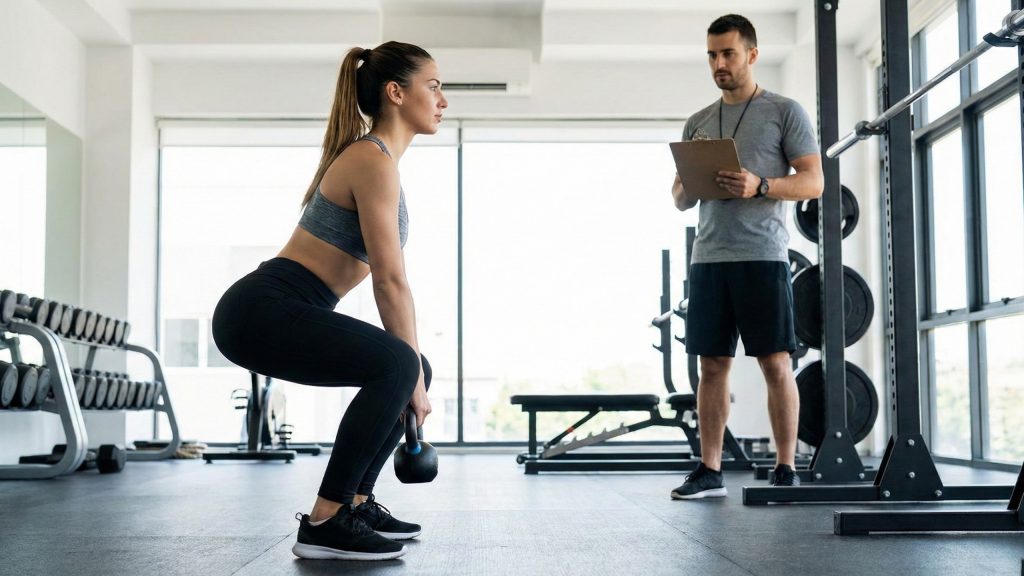
Equipment You Might Need (But Don’t Overbuy)
One of the most common forms of procrastination is “productive procrastination”—Spending hours researching the perfect home gym setup or buying expensive activewear before ever doing a push-up. The truth is, fitness is a biochemical process, not a commercial one. Your body does not know if you are lifting a gold-plated dumbbell or a milk jug; it only understands tension.
However, a few strategic purchases can improve safety and comfort. Here is how to navigate the gear landscape without emptying your wallet.
Essential Beginner Gear
Before buying weights or machines, prioritize items that remove physical discomfort. If you are comfortable, you are more likely to stay consistent.
- Proper Footwear: This is the only non-negotiable investment. Running in flat-soled casual sneakers can lead to shin splints and plantar fasciitis.
- For Running/Cardio: Look for cushioned running shoes with arch support.
- For Strength Training: You want a flat, stable sole (like Converse or specialized cross-trainers) to transfer force into the ground. Avoid squishy running shoes for heavy squats.
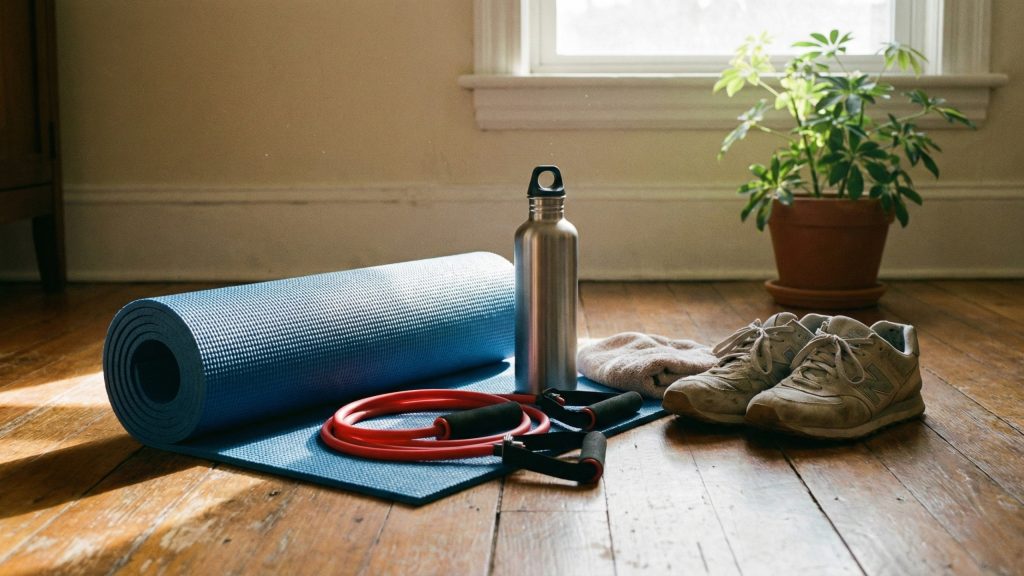
- A High-Quality Yoga Mat: A thin, slipping mat makes planks and sit-ups miserable. Look for a mat that is at least 5mm thick with a non-slip texture. This transforms a hard living room floor into a designated workout zone.
- A Reusable Water Bottle: Hydration affects performance. Having a bottle visually available during your workout acts as a cue to drink between sets.
- Comfortable Clothing: You do not need compression gear. You need clothes that do not restrict your range of motion. If you have to adjust your waistband or sleeves during a workout constantly, it breaks your mental focus.
What to Look for in Affordable Equipment
If you are ready to add resistance beyond gravity, look for equipment that offers High Versatility and Low Storage Footprint.
- Resistance Bands (The Best ROI):
- Why: They are inexpensive, portable, and joint-friendly. Unlike free weights, bands provide “variable resistance”—they get harder the further you stretch them, which matches the natural strength curve of your muscles.
- What to Buy: A set of “loop” bands (mini-bands) for glute activation and a set of “tube” bands with handles for upper body pressing and pulling.
- Adjustable Dumbbells:
- Why: Buying a rack of individual dumbbells ($5\text{lb}, 10\text{lb}, 15\text{lb}\dots$) takes up a whole wall and costs a fortune.
- What to Buy: A pair of selectorized adjustable dumbbells lets you change the weight from 5lbs to 50lbs with a dial. They are an upfront investment that saves money and space in the long run.
- Kettlebells:
- Why: One single kettlebell (e.g., 16kg for men, 8kg for women) can deliver a full-body cardio and strength workout.
- What to Buy: Look for cast iron (indestructible). Avoid plastic-filled cement bells, as they can crack and are often awkwardly large.
Pro Tip: Check online marketplaces (Facebook Marketplace, Craigslist). Exercise equipment is one of the most frequently resold categories. You can often find “like new” weights for 50% of the retail price.
How to Use Minimal Equipment Effectively
You do not need a gym full of machines to stimulate muscle growth. You need to understand how to manipulate intensity variables. If you only have a pair of light dumbbells, you can still get a challenging workout by changing your movement.
- Manipulate Tempo (Time Under Tension):
- Instead of lifting a weight quickly, slow it down. Take 3 seconds to lower the weight and 1 second to lift it. This forces the muscle to work harder to control the load, making a light weight feel heavy.
- Unilateral Training:
- If you have a 20lb weight and you use two hands (e.g., a goblet squat), it’s 20lbs of load. If you hold it in one hand or stand on one leg (e.g., a split squat), you effectively double the stability demand and load on that limb.
- Compound Movements:
- Combine movements to increase caloric burn. Instead of just standing and doing a bicep curl, do a Reverse Lunge into a Curl. This utilizes multiple muscle groups simultaneously, maximizing the utility of light equipment.
- Household Substitutes:
- No weights? A backpack filled with books or water bottles is an excellent substitute for a weighted vest or sandbag.
- No bench? A sturdy chair or the edge of a couch works perfectly for tricep dips or Bulgarian split squats.
How to Stay Motivated and Overcome Plateaus
The initial burst of enthusiasm that starts a fitness journey is called “starter energy.” It is powerful but finite. When it inevitably runs out, you need a backup power source. That source is a combination of deep purpose and strategic goal setting.
Finding Your Why
Surface-level goals like “I want to lose 10 pounds” or “I want to look good for a wedding” are rarely strong enough to withstand the temptation of a warm bed on a cold morning. You need to dig deeper to find your Intrinsic Motivation.
Try the “Five Whys” exercise to peel back the layers:
- I want to get fit. Why?
- Because I get winded playing with my kids. Why does that matter?
- Because I want to be an active parent, not a spectator. Why?
- Because my father couldn’t play with me, and I want to change that legacy.
- The Result: “Breaking a generational cycle” is a much stronger motivator than “losing 10 pounds.” Write this “Why” down and place it somewhere visible.
Setting Short-Term and Long-Term Goals
A long-term goal is your destination; short-term goals are the mile markers. Without the mile markers, the destination feels impossibly far away.
Use the SMART framework to structure these mile markers:
- Specific: Instead of “get stronger,” use “perform 5 push-ups.”
- Measurable: You can count it.
- Achievable: It is realistic for your current level.
- Relevant: It aligns with your “Why.”
- Time-bound: “By the end of this month.”
The Ladder Strategy:
- Long-Term Goal (1 Year): Run a 5K.
- Medium-Term Goal (3 Months): Run 1 mile without stopping.
- Short-Term Goal (This Week): Walk/Jog intervals for 20 minutes, three times.
Tips for Staying Consistent
Consistency is not about willpower; it is about environmental design. You want to make the “good choice” the easy choice.
- The “Never Miss Two” Rule: Missing one workout is a slip; missing two is the start of a new, sedentary habit. If you miss a Tuesday session, prioritizing Wednesday becomes non-negotiable.
- Habit Stacking: Anchor your workout to a habit you already do. “After I pour my morning coffee, I will immediately put on my gym shoes.”
- The Accountability Partner: We are less likely to disappoint others than ourselves. Arrange to meet a friend for a walk or share your workout log with a partner. If you don’t have a partner, even a digital community or a social media post can provide necessary social pressure.
When to Level Up Your Routine
A beginner routine is a launchpad, not a permanent residence. The human body is an adaptation machine; once it adapts to a stress (exercise), that stress no longer provokes a change. To keep improving, you must introduce new challenges.
Signs You’re Ready for More
How do you know it is time to graduate from “beginner” to “intermediate”? Look for these indicators:
- RPE Drop: The workout that used to leave you breathless and sore (Rate of Perceived Exertion 8/10) now feels like a warm-up (RPE 4/10).
- Plateaued Results: Your weight loss has stalled, or your strength numbers haven’t budged for 3–4 weeks despite consistent effort.
- Perfect Recovery: You are no longer sore the next day, and you feel energetic immediately after finishing the session.
- Boredom: Mentally, you are checking out. Engagement is critical for focus; if the routine is too easy, your mind wanders.
How to Gradually Increase Difficulty
The scientific term for “leveling up” is Progressive Overload. This doesn’t always mean “adding weight.” There are four main dials you can turn:
- Intensity (Load): Lift heavier weights. (e.g., 10lbs $\rightarrow$ 12lbs).
- Volume (Quantity): Do more reps or sets. (e.g., 2 sets of 10 $\rightarrow$ 3 sets of 10).
- Density (Time): Do the same work in less time. (e.g., resting 60 seconds between sets $\rightarrow$ resting 45 seconds).
- Complexity (Skill): Choose a harder variation. (e.g., Knee Push-ups $\rightarrow$ Incline Push-ups $\rightarrow$ Standard Push-ups).
The 5% Rule: A safe rate of progression is increasing the total workload by roughly 5–10% per week. Any more invites injury.
Sample Progression Plan
Here is what a 4-week evolution looks like for a basic bodyweight squat. Notice how the difficulty ramps up without changing the exercise entirely.
| Week | Goal | Modification | Focus |
| Week 1 | Form Mastery | Assisted Squat (holding a chair) | 3 sets of 8 reps. Focus on depth and keeping heels down. |
| Week 2 | Volume | Bodyweight Squat (hands out for balance) | 3 sets of 10-12 reps. Focus on smooth movement. |
| Week 3 | Density | Bodyweight Squat | 3 sets of 12 reps. Reduce rest between sets from 90s to 60s. |
| Week 4 | Intensity | Goblet Squat (holding a water bottle/weight) | 3 sets of 8 reps. Adding external load to restart the strength cycle. |

Tips for Building a Supportive Routine
Willpower is a finite resource; a routine is an automated process. The Goal of building a “supportive” routine is to remove the daily negotiation of “Should I work out?” and replace it with a system that decides for you. A supportive routine doesn’t just demand energy from you; it eventually gives energy back by reducing stress and decision fatigue.
Creating a Routine That Fits Your Schedule
The most perfect workout plan is useless if it requires 90 minutes you do not have. To build a routine that survives the chaos of real life, you must treat exercise as an appointment, not an option.
- The Time Audit: Track your time for three days. You will likely find “dead zones”—15 minutes of scrolling social media in the morning or 20 minutes of watching TV after dinner. These are your workout windows.
- Time Blocking: Open your calendar and schedule your workouts for the month in advance. Mark them as “Unavailable/Meeting.” If a conflict arises, you don’t cancel the appointment; you reschedule it, just as you would with a doctor or a client.
- The “Bookend” Strategy:
- Morning: Exercise immediately upon waking. This ensures the day’s unpredictability (late meetings, traffic, fatigue) cannot derail your plan.
- Evening: Exercise as a transition ritual between work and home life. It acts as a mental partition, allowing you to “leave work behind” before relaxing.
- Micro-Workouts: If you cannot find a continuous 30-minute block, find three 10-minute blocks. Research suggests that “exercise snacking” (breaking activity into short bursts) can be just as effective for general health as one long session.
How to Make Exercise a Habit
A habit is formed when a behavior becomes automatic. To achieve this, you must manipulate your environment to reduce friction (the effort required to start) and increase Reward.
- Reduce Friction (The 20-Second Rule): Make it easier to work out than to skip it.
- Pack your bag the night before.
- Sleep in your gym clothes (if you work out in the morning).
- Keep equipment visible. Do not hide your yoga mat in a closet; leave it unrolled on the floor.
- Implementation Intentions (If/Then Planning): Prepare for obstacles before they happen.
- “If I get stuck at work late and miss the gym, then I will do 15 minutes of stretching in the living room.”
- “If it is raining and I can’t walk, then I will do a dance workout video on YouTube.”
- The “Two-Minute Rule”: On days when you feel zero motivation, commit to doing just two minutes of exercise. Put on your shoes and do five squats. Often, the hardest part is starting. Once you are moving, you will likely continue. If not, at least you kept the habit alive.
Finding a Workout Buddy or Community
Humans are social animals. We are biologically wired to care what others think of us. Leveraging this social pressure is one of the most effective ways to ensure adherence.
- The “Kohler Effect”: Psychological research shows that people work harder when performing in a group than when working alone. We naturally try to match the effort of those around us.
- Types of Support:
- The Pacer: Someone at your fitness level with whom you can compete or progress alongside.
- The Mentor: Someone more advanced who can teach you form and provide advice.
- The Cheerleader: A friend who might not work out with you but asks, “How was your workout?” and celebrates your wins.
- Digital Communities: If you don’t have local friends interested in fitness, online communities (Strava groups, Reddit forums like r/bodyweightfitness, or Fitbit challenges) provide a sense of belonging. Posting your workout log to a group creates “virtual accountability”—you don’t want to break your streak in front of the audience.
Frequently Asked Questions
How often should beginners exercise?
Consistency beats intensity. For most beginners, aiming for 3 to 4 days per week is the sweet spot. This frequency provides sufficient stimulus to trigger health benefits while allowing ample recovery time. As you adapt, you can gradually increase this to 5 days, perhaps by adding active recovery days (like walking) on non-training days.
What should I do if I feel sore after working out?
Soreness, known as Delayed Onset Muscle Soreness (DOMS), is typical when starting a new routine. It usually peaks 24–48 hours after exercise.
- Do: Keep moving gently. Light walking or stretching increases blood flow, which aids recovery.1 Hydrate well and prioritize sleep.
- Don’t: Sit perfectly still; stiffness will worsen. However, if the pain is sharp or in your joints, rest immediately.
Can I do these routines at home?
Absolutely. Home workouts remove the barriers of travel time and “gymtimidation.”2 Bodyweight exercises (squats, push-ups, lunges) and simple cardio (marching, dancing) require zero gym space.3 The best workout is the one you actually do, regardless of where it happens.+1
Do I need special equipment for beginner routines?
No. Your body is the best tool you own. Gravity provides plenty of resistance for beginners.4 The only “equipment” you truly need is comfortable clothing, supportive shoes, and a water bottle. As you progress, you might add resistance bands or dumbbells, but they are not required to start.
How long should a beginner’s workout last?
Length is less important than quality. A focused 20 to 30-minute session is sufficient to build strength and cardiovascular health.5 Long, grueling hour-long sessions often lead to burnout for beginners. It is better to do 20 minutes with high focus than 60 minutes with low energy.
Is it normal to feel unmotivated at first?
Yes, extremely normal. Motivation is an emotion, and emotions fluctuate. The first few weeks are the hardest because the habit hasn’t formed yet, and the physical results aren’t visible. Do not rely on “feeling like it.” Rely on your schedule and discipline until the habit sticks.
Should I consult a doctor before starting?
If you have been sedentary for an extended period, are over age 45, or have any pre-existing medical conditions (heart issues, diabetes, joint problems), the answer is a definitive yes. A quick check-up ensures you are cleared for activity and helps you understand any specific limitations to observe.
How do I know if I’m doing the exercises correctly?
- Feel: You should feel the tension in the target muscle (e.g., quads in a squat), not in your joints (e.g., knees or lower back).
- Visual: Use a mirror to check your form against tutorial videos.
- Feedback: If you are unsure, film yourself with your phone and compare it to a pro’s form, or book a single session with a certified trainer to learn the basics.
Can I combine different types of beginner routines?
Yes, this is often encouraged! This is called Concurrent Training. For example, you might do strength training on Monday and Wednesday, and a cardio/yoga routine on Tuesday and Thursday. This variety prevents boredom and builds a well-rounded athletic base.6
What if I miss a workout?
Forgive yourself immediately and move on. Missing one workout does not ruin your progress; quitting because you feel guilty does. Adopt the “Never Miss Two” rule: if you miss Tuesday, make sure you show up Thursday. Consistency is about the long average, not a perfect streak.7
How do I stay motivated when results are slow?
Shift your focus from “aesthetic” goals (weight loss) to “performance” goals.
- Track Non-Scale Victories: Are you sleeping better? Do you have more energy at 3 PM? Can you carry groceries more easily?
- Trust the Process: Physiological changes happen internally (blood pressure, heart health) weeks before they show up in the mirror.
Are there beginner routines for older adults?
Yes. Strength training is arguably more important as we age to combat sarcopenia (muscle loss) and osteoporosis (bone density loss).8 Routines for older adults often focus on balance, stability, and functional movements (like sit-to-stands).9 Always prioritize low-impact movements to protect joints.+1
How do I prevent injuries as a beginner?
- Warm Up: Never start cold.
- Form First: Never sacrifice good form to lift more weight.
- Progress Slowly: follow the “10% Rule”—never increase your distance or weight by more than 10% per week.
- Listen to Pain: Stop immediately if you feel sharp pain.10
What’s the best time of day to exercise?
The best time is the time you will actually stick to.
- Morning exercisers often have better consistency because life hasn’t gotten in the way yet.11
- Evening exercisers may have higher body temperature and strength performance.
- Ultimately, consistency matters more than circadian optimization.
Can I do beginner routines while pregnant?
Generally, exercise is beneficial during pregnancy, but you must consult your obstetrician first.12
- modifications are usually needed (e.g., avoiding lying flat on your back after the first trimester, avoiding fall risks).13
- The Goal shifts from “improving fitness” to “maintaining health.” Listen to your body and keep intensity moderate (you should be able to hold a conversation).
Conclusion
Small steps, done consistently, create the kind of momentum that changes everything. When you keep your workouts simple, focus on solid form, and permit yourself to grow gradually, fitness stops feeling intimidating and starts feeling doable. That’s the real win of beginner routines: they help you build confidence, strength, and a sustainable habit you can actually maintain. If you’re ready to keep going, explore more guidance, ideas, and beginner-friendly plans on the Beginner Routines page.
Recommended Resources to Keep You on Track
As you continue your journey, knowing where to find reliable information is just as important as the workout itself.
- For Motivation and Psychology: If you want to dive deeper into the science of why “starting small” works, we highly recommend exploring the Tiny Habits method by Dr. BJ Fogg. His research on behavioral psychology is the foundation for building habits that stick without relying on willpower.
- For Form and Safety: When you are trying a new exercise and aren’t sure if you are doing it right, the American Council on Exercise (ACE) Exercise Library is an invaluable tool. It features detailed videos and descriptions for almost every movement, ensuring you stay safe and injury-free.
- For Long-Term Goals: As you build endurance, it is helpful to know what “healthy” looks like by medical standards. The CDC Physical Activity Guidelines provide a clear, science-backed roadmap for how much activity adults need to maintain optimal health.